For many entrepreneurs, DSers has been the gateway into the world of dropshipping. Its straightforward integration with AliExpress and Shopify simplifies those first, crucial steps. But what happens when your store outgrows the basics? When customer expectations shift from "cheap and slow" to "reliable and fast," and your brand identity demands more than generic packaging?
This comprehensive guide is for the dropshippers who is ready to level up. We'll dive deep into the best DSers alternatives of 2026, comparing them across supplier diversity, automation, branding, and fulfillment speed.
Key Takeaways
- Beyond Beginner Tools: DSers works for testing but limits scaling due to AliExpress dependency, slow shipping, and lack of branding options.
- Regional Focus Matters: Different alternatives excel in different markets—US fulfillment (Zendrop), premium US/EU products (Spocket), global sourcing (EPROLO).
- Branding as Differentiator: Platforms like EPROLO offer comprehensive branding services that help transition from reseller to brand owner.
- Automation vs. Simplicity: Choose based on your needs—full automation (AutoDS) for scaling stores versus user-friendly interfaces (EPROLO) for growing businesses.
Table of Contents
Why Are Dropshippers Actively Seeking DSers Alternatives?
DSers is a dropshipping fulfillment automation tool that acts as a bridge between Shopify stores and AliExpress. It allows merchants to import products in bulk, process large volumes of orders with a few clicks, and track fulfillment from a centralized dashboard.
As an official partner for AliExpress, Shopify, and now Squarespace, DSers played a major role in streamlining AliExpress dropshipping after Oberlo shut down. For beginners, it effectively solved early operational pain points and remains a viable tool for testing products.
However, the growing search for a DSers alternative is not about DSers being "bad." It's about businesses outgrowing the AliExpress-based model. As stores mature and customer expectations rise, the limitations of the ecosystem DSers relies on become more apparent.
The most common reasons driving merchants to seek alternatives include:
- The AliExpress Dependency Trap: Your entire supply chain depends on a single, volatile marketplace. Supplier reliability, product quality, pricing, and inventory levels can change without warning, creating operational risk as order volume increases.
- The Shipping Speed Ceiling: In an era shaped by Amazon Prime, 30–50 day shipping times are a conversion killer. Long delivery windows lead to abandoned carts, negative reviews, refunds, and chargebacks.
- The Branding Barrier: Building a trustworthy brand is difficult when every order arrives in generic packaging with no custom inserts or identity. DSers offers minimal support for white-label services or branded packaging, keeping stores stuck in a reseller model.
- Scaling Limitations: As sales grow, merchants need more than basic order automation. Inventory syncing, supplier stability, and scalable fulfillment workflows become critical—areas where DSers remains relatively basic.
- The Hidden Cost of "Affordability": While DSers is inexpensive, slow shipping, customer support issues, lost repeat purchases, and an inability to charge premium prices often become hidden costs that hurt long-term profitability.
For many sellers, these challenges eventually lead to a breaking point.
DSers vs. The Competition: 2026 Feature Snapshot
| Platform | Source From | Avg. Shipping | Automation Level | Branding Support | Best For |
|---|---|---|---|---|---|
| DSers | AliExpress | 15-45 days | Basic | None | AliExpress beginners |
| EPROLO | Global Network (CN, US) | 7-15 days | High | Excellent | Overall best for scaling |
| Zendrop | Curated CN + US Fulfillment | 4-14 days | Moderate | Good | Speed-focused US stores |
| CJdropshipping | Massive CN Network + Warehouses | 10-25 days | Moderate | Good | High variety, low cost |
| Spocket | Vetted US & EU Suppliers | 2-10 days | Moderate | Good | Premium US/EU products |
| AutoDS | Multi-Source | Varies by source | Advanced | Moderate | Automation-obsessed seller |
| Syncee | Global B2B Wholesalers | Varies by supplier | High | Moderate | Wholesale/unique catalogs |
Top DSers Alternatives for 2026
1. EPROLO
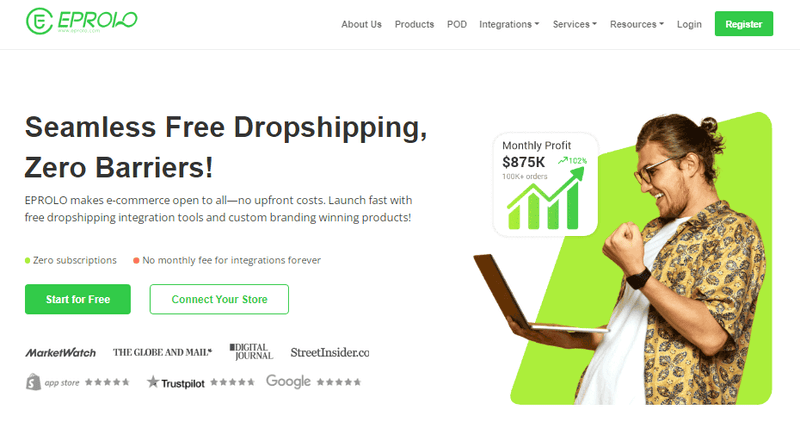
EPROLO is a popular free dropshipping supplier. It provides a similar user-friendly experience but swaps the chaotic AliExpress marketplace for a curated global supplier network with a heavy emphasis on branding.
Key Features:
- Global Supplier & Warehouse Network: Access to suppliers in China, the US, Europe, and Australia, enabling faster regional shipping.
- Comprehensive Branding Suite: Full white-label and private label services, including custom packaging, logos, and inserts.
- Product Sourcing Service: Can find and vet suppliers for specific products you request.
- POD Service: Its built-in print-on-demand feature allows you to sell custom products without inventory.
Pros:
- Successfully balances ease-of-use with powerful features.
- Superior branding options are built into the core service.
- More reliable and consistent than AliExpress-dependent platforms.
- Offers a viable path from AliExpress-style to branded, fast-shipping products.
Cons:
- Product catalog, while large, isn't as vast as AliExpress.
- Can be slightly more expensive than pure AliExpress agents.
Ideal User: Merchants who have validated products with DSers and want faster shipping and branding options.
2. Zendrop – Best for Prioritizing US Fulfillment & Speed

Zendrop's entire value proposition is built on speed and reliability. It actively moves popular products into US-based fulfillment centers, dramatically cutting shipping times.
Key Features:
- US Fulfillment Hubs: Stocks best-selling items in US warehouses for 3-7 day domestic delivery.
- Product Sourcing & Iteration: Helps find winning products and offers "product iteration" to improve existing best-sellers.
- Subscription Model: Free plan for basic features, paid plans for faster processing and premium support.
Pros:
- The fastest shipping option on this list for US customers when using US fulfillment.
- Clean, intuitive interface.
- Good middle-ground between AliExpress speed and Spocket's higher cost.
Cons:
- The US-stocked catalog is limited to best-sellers.
- Costs are higher than CJdropshipping or DSers for the same base product.
Ideal User: Merchants primarily targeting US customers and needing fast shipping to boost conversions.
3. CJdropshipping
If you love the endless selection of AliExpress but want more control and slightly better service, CJdropshipping is a powerful, albeit complex, alternative. It's a massive sourcing platform with its own logistics network.
Key Features:
- Enormous Product Catalog: Comparable to AliExpress, with constant new additions.
- Global Warehouses: Offers shipping from China, US, Europe, and other regions.
- Full-Service Options: Provides product sourcing, photography, video, and packaging customization.
- Print-on-Demand (POD): Integrated POD service for customized products.
Pros:
- Unbeatable product variety and low-cost goods.
- More communication and control over orders than with random AliExpress sellers.
- A "one-stop-shop" with many value-added services.
Cons:
- The website and interface can feel clunky and overwhelming.
- Quality control is your responsibility unless you pay for inspection.
- Communication can require patience and persistence.
Ideal User: Hands-on merchants who need a wide range of products and are comfortable managing supplier relationships.
4. Spocket

Spocket skips China altogether for its premium suppliers. It connects you primarily with vetted distributors in the United States, Europe, and other Western countries, focusing on quality and speed.
Key Features:
- US & EU Supplier Focus: Products are sourced from within these regions.
- Fast, Reliable Shipping: Typical delivery times of 2-10 business days.
- Branded Invoicing: Customers receive an invoice with your store's name, not the supplier's.
- Sample Orders: Easily order product samples to test quality before selling.
Pros:
- Enables truly fast shipping to Western customers.
- Higher, more consistent product quality.
- Builds greater customer trust and allows for premium pricing.
- Excellent for building a "local" brand feel.
Cons:
- Product costs are significantly higher than AliExpress-sourced goods.
- The product catalog is smaller and less suited for ultra-trendy, disposable items.
- MOQs (Minimum Order Quantities) may apply for some suppliers.
Ideal User: Dropshippers focused on building a premium brand with quality products, particularly in North America or Europe.
5. AutoDS

AutoDS is less of a supplier platform and more of an all-in-one automation tool. It's designed for sellers who want to systematize every part of their business, from sourcing to fulfillment, often across multiple supplier sources.
Key Features:
- Hyper-Automation: Automates price/stock monitoring, order processing, tracking updates, and even product imports based on rules.
- AI-Powered Tools: Includes product research filters, competitor analysis, and demand forecasting.
- 360° Business Dashboard: Provides deep analytics on profitability, supplier performance, and product trends.
Pros:
- The most powerful automation suite available for dropshippers.
- Frees up massive amounts of time for marketing and strategy.
- Allows you to build a diversified, multi-source supply chain in one dashboard.
Cons:
- Steep learning curve due to its complexity.
- Higher monthly cost, justified by the automation power.
- Can be "overkill" for simple, single-supplier stores.
Ideal User: Tech-savvy, data-driven online sellers running high-volume or multi-store operations, seeking automation for maximum efficiency.
6. Syncee – Best for Wholesale & B2B-Style Product Catalogs

Syncee operates in a different lane. It connects you not with marketplaces like AliExpress, but with established wholesalers, distributors, and manufacturers worldwide, offering data feeds you can sync to your dropshipping store.
Key Features:
- Global B2B Marketplace: Access to thousands of wholesalers with unique, often brand-name products.
- Data Feed Management: Easily import, map, and sync complex supplier product feeds with custom rules.
- Bulk Edit & Inventory Sync: Manage large catalogs efficiently with real-time sync.
Pros:
- Access to unique products not available on general marketplaces.
- Often better pricing at volume than AliExpress.
- More stable supplier relationships with established businesses.
Cons:
- Requires a more "wholesale" mindset; less about trendy impulse buys.
- May involve direct communication with suppliers for account setup.
- Less of an "all-in-one" fulfillment solution; some suppliers may drop-ship, others may require inventory.
Ideal User: Dropshippers looking to build a unique, curated catalog and move beyond typical dropshipping models.
Decision Matrix: Which DSers Alternative is Perfect for Your Store?
Stop analyzing features and start matching a platform to your specific business goals:
- "I'm a beginner, but I want to start with a better foundation than AliExpress."
Recommendation: EPROLO. It offers a familiar ease-of-use while immediately providing better suppliers and a path to branding. - "My #1 problem is shipping time. My US customers complain constantly."
Recommendation: Zendrop (for speed) or Spocket (for speed + quality). Prioritize platforms with US-based inventory. - "I want to build a recognizable, premium brand with custom packaging."
Recommendation: EPROLO. Its branding suite is the most comprehensive and integrated. - "I sell a huge variety of low-cost items and need the widest selection possible."
Recommendation: CJdropshipping. It's the closest direct alternative to the AliExpress catalog. - "I'm scaling to 50+ orders/day and need to automate everything to save time."
Recommendation: AutoDS. The investment in its automation will pay for itself in time saved and errors prevented. - "I want to sell unique, higher-quality, or niche products not found on AliExpress."
Recommendation: Spocket or Syncee. Both connect you with suppliers outside the mainstream AliExpress ecosystem.
How to Switch from DSers to A New Platform
Migrating from DSers to EPROLO requires planning to avoid fulfillment errors, delayed orders, or lost revenue. Follow this structured process to ensure a smooth transition.
Phase 1: Preparation (Before Installing EPROLO)
Identify Your Best-Selling Products
Review your Shopify analytics and identify the top 20% of products generating the majority of your revenue. These products should be prioritized during the migration.
Export Important Data
Export your product list from Shopify and review any active or pending orders in DSers. Make sure all existing DSers orders are clearly tracked before moving forward.
Phase 2: Install EPROLO & Test in Parallel
Install and Connect EPROLO
Install the EPROLO app from the Shopify App Store and connect your store. Keep DSers installed during this phase to prevent fulfillment disruption.
Source and Import Key Products
Use EPROLO's product catalog or sourcing request feature to find your best-selling items. Import products into Shopify and tag them (for example, "EPROLO-TEST") to avoid confusion.
Place Test Orders
Submit test orders to verify the entire fulfillment process—from order syncing and processing to tracking number generation and customer notifications.
Phase 3: Cutover to EPROLO (Critical Step)
Temporarily Pause Paid Traffic
Briefly pause paid ads to reduce incoming orders during the switch.
Complete All DSers Fulfillments
Allow all existing DSers orders to finish processing and shipping before redirecting new orders.
Route New Orders to EPROLO
Disable DSers' automatic order fulfillment and confirm that EPROLO is capturing and processing all new orders.
Replace DSers-Linked Listings
Once testing is successful, remove DSers-linked product listings and publish the EPROLO-sourced versions. Update product URLs in ads and social channels if needed.
Phase 4: Post-Migration Monitoring
Closely Monitor Initial Orders
Monitor the first 50–100 EPROLO orders closely to ensure accurate fulfillment, shipping updates, and customer notifications.
Update Customer Support Information
Brief your support team on new shipping times, tracking formats, and fulfillment workflows.
Uninstall DSers
Only remove DSers after confirming that all previous orders are completed and EPROLO fulfillment is stable.
Conclusion: Choosing Your Path Beyond AliExpress
Moving from beginner dropshipping to building a real brand requires better tools over time. DSers is a solid starting point, but growing stores need more advanced solutions.
In 2026, the right choice depends on your goals. If you want a stable, customer-focused brand that can scale and adapt, switching to a dropshipping platform like EPROLO, Spocket, or AutoDS isn't an extra cost—it's a necessary upgrade.
Successful merchants grow by adapting to faster shipping expectations, higher quality standards, and bigger ambitions. Choosing the right DSers alternative may be the most important step you take this year.
DSers Alternatives: FAQs
1. Is DSers still worth using in 2026?
For a complete beginner with no capital who wants to learn the mechanics of dropshipping with zero risk, yes. For anyone with a store doing over $1k/month, the limitations will likely outweigh the benefits. Alternatives offer better ROI through higher conversion rates and customer retention.
2. What is the best free DSers alternative?
EPROLO is widely considered the best free DSers alternative. It offers product sourcing, automated order fulfillment, and branding services with no mandatory subscription, making it ideal for scaling beyond AliExpress without upfront costs.
3. Which alternative is best for sourcing custom or private label products?
EPROLO is the leader here, with dedicated sourcing and white-label teams. CJdropshipping also offers strong custom sourcing services.
4. Do I have to change all my products at once when I switch?
No. A hybrid approach is smart. Migrate your best-sellers first to the new, faster/branded platform. Leave slow-moving, long-tail products on DSers until you phase them out or find replacements.
Read More from EPROLO Blog
Written by Iris
Iris is a digital marketing expert with 3+ years of experience in e‑commerce and dropshipping. She helps online store owners grow their sales through SEO-friendly content, supplier guides, and practical marketing tips, making it easier to run and scale profitable stores.