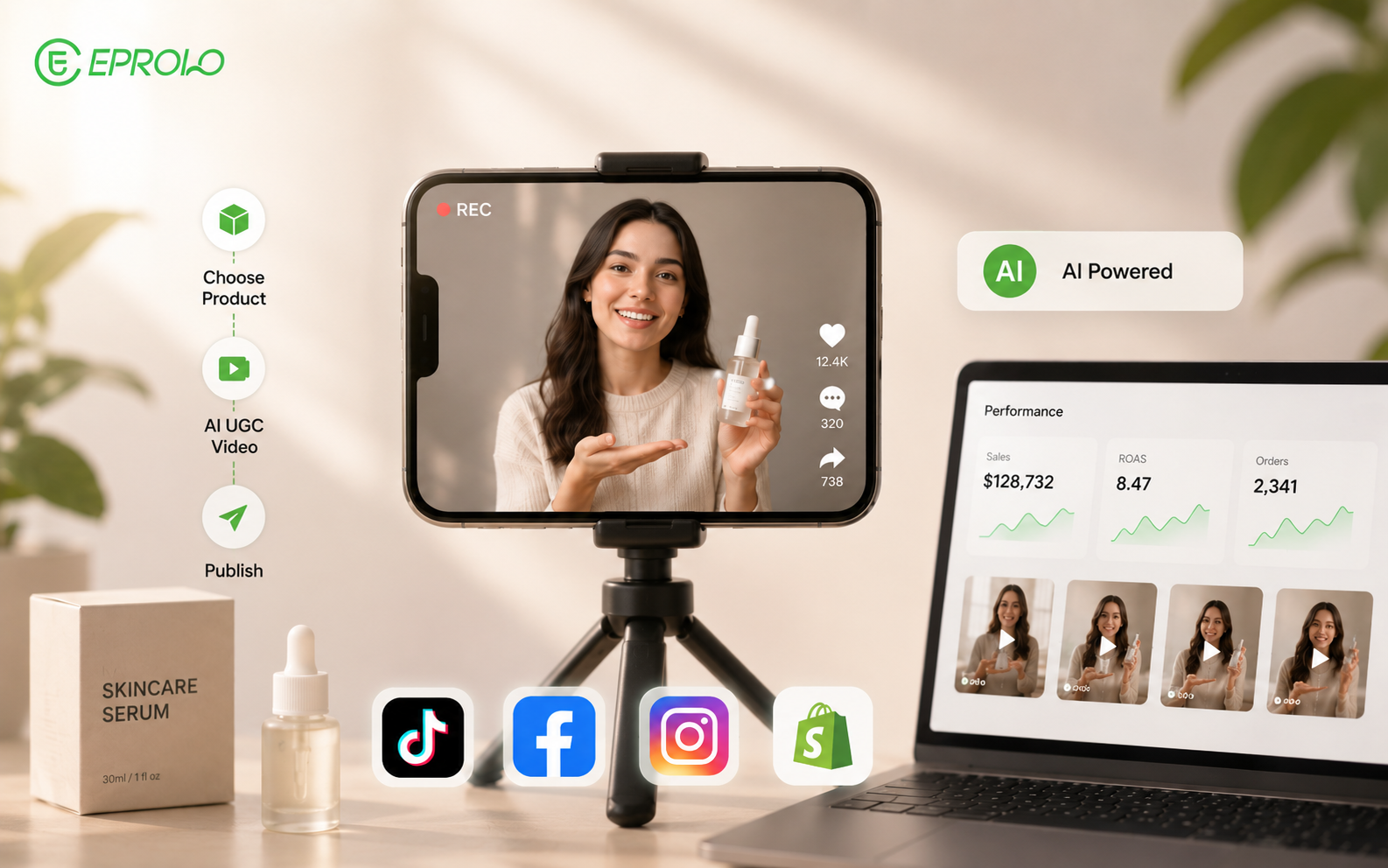
Short-form video has become an important creative format for ecommerce advertising, but developing sufficient variations for meaningful testing can be time-consuming when every angle requires a separate physical shoot. AI UGC ad creators reduce the manual production time required to draft and iterate on video concepts, making it easier for merchants to test different hooks, product angles, offers, and presenters.
AI UGC ad creators can turn product pages and existing catalog assets into testable video variations in minutes. However, faster production does not guarantee better conversion rates. This guide compares five AI video tools using ecommerce-focused evaluation criteria, outlines a practical direct-response workflow, and explains how to connect rapid creative testing with dependable dropshipping fulfillment to scale sustainably.
Key Takeaways
- AI UGC tools accelerate creative iteration by converting catalog links and assets into testable video concepts, but production speed does not replace genuine product-market fit.
- Synthetic presenter videos require human review for product accuracy, advertising claim substantiation, and platform-specific AI disclosure requirements.
- Creative testing success must be coordinated with supplier inventory and route-specific shipping capacity before increasing ad budgets.
Table of Contents
- What Are AI UGC Ad Creator Tools and How Do They Work for Dropshipping?
- Why AI UGC Video Ads Can Help With Dropshipping Testing
- 5 AI UGC Ad Creator Tools to Consider in 2026
- How to Create and Test Your First AI UGC Video Ad for Dropshipping (Step-by-Step)
- How to Run AI UGC Videos: Free Organic Traffic vs. Paid Ads
- Common Mistakes Dropshippers Make with AI UGC Ads
- Scaling Your Dropshipping Store with AI UGC Ads
- Frequently Asked Questions
- Related Reading
What Are AI UGC Ad Creator Tools and How Do They Work for Dropshipping?
Many AI UGC ad creators combine language models, product-page or asset extraction, synthetic presenters or voices, image and video generation, templates, captions, and editing tools. The software aims to reproduce the pacing and direct-response structure of creator content. The output is synthetic advertising, not genuine customer-generated content, so merchants must review claims and disclose AI use when platform rules require it.
For dropshippers, these tools serve as a rapid creative-testing workflow. Because AI-generated ads involve synthetic presenters and direct product claims, merchants must comply with consumer protection standards and platform advertising rules. In the United States, this includes the FTC Endorsement Guides and regulatory rules prohibiting fake consumer reviews and testimonials. Additionally, major ad networks like TikTok and Meta maintain synthetic media policies that require disclosure badges or AI labeling for significantly modified and AI-generated creative assets. Because platform requirements evolve frequently, always verify current campaign settings before scaling spend.
Why Dropshippers Use AI UGC Workflows
Dropshipping advertisers have traditionally used supplier footage, freelance creators, influencers, or in-house production to develop ad creative. AI UGC offers another production option that can be particularly useful when merchants need to develop multiple concepts quickly. Its main advantages are creative iteration, early product validation, and localization:
- Iterating Against Creative Fatigue: Creative fatigue can occur when the same audience is repeatedly exposed to similar ads. The timing varies by audience size, spend, frequency, placement, product category, and creative quality. AI tools can reduce the production effort required to develop fresh hooks and creative concepts, allowing merchants to respond to performance changes without rebuilding every asset from scratch.
- Early Market Signal Gathering: Merchants can use low-cost creative tests to gather early signals about audience interest before committing to larger inventory purchases or advertising budgets. Creative performance is only one demand signal and should be evaluated alongside product economics, customer feedback, and fulfillment feasibility.
- Multilingual Draft Production: Many current AI video platforms support multilingual voice generation, translation, and lip synchronization. However, quality varies by language, voice model, accent, script, and platform. For localized campaigns, have a native or professionally qualified reviewer check pronunciation, meaning, cultural fit, product claims, and on-screen text before publishing.
How Product Links Turn into Video Ads
Most AI UGC ad creators follow a streamlined automation pipeline to transform a product link and catalog assets into deployable video variations:
- The tool reads accessible product-page text, images, variants, price, benefits, and brand context.
- A script model produces hooks, problem-solution framing, scenes, proof points, and a call to action.
- The user chooses an avatar, voice, language, style, duration, and aspect ratio.
- The generator combines the presenter, product assets, stock or generated b-roll, music, captions, and transitions.
- A human checks product accuracy, pronunciation, claims, synthetic-media disclosure, price, offer, and shipping promise.
- Approved versions can then be exported for TikTok, Reels, Shorts, or paid placements. For structured testing, vary either the overall creative concept or a clearly defined creative element so that performance differences can be interpreted reliably.
This automated workflow compresses the production cycle from days to minutes, though choosing whether to deploy synthetic avatars or source authentic human creators remains an essential strategic decision.
AI Avatars vs. Human Creators: Core Operational Differences
Understanding when to use synthetic AI presenters versus hiring real human UGC creators is critical for managing ad spend and customer trust:
| Factor | AI Avatars | Human Creators |
|---|---|---|
| Speed | Fast variants and localization. | Briefing, samples, filming, and revisions take longer. |
| Cost | Subscription or credit based. | Per deliverable plus samples and usage rights. |
| Authenticity | Synthetic and disclosure-sensitive. | Can document real experience and product handling. |
| Product Evidence | Depends on available product assets and generation quality. May distort hands, fit, or textures. | Can physically handle, wear, test, and demonstrate genuine tactile results. |
| Best Stage | Initial hook testing, catalog batch drafts, explainers, localization. | Scaling proven concepts, high-trust categories, and premium offers. |
Typical operational differences; actual costs and workflows vary by platform and creator agreement.
Why AI UGC Video Ads Can Help With Dropshipping Testing
Dropshipping success depends on testing combinations of products, hooks, audiences, and offers before marketing capital is depleted. Vertical video is well suited to mobile-first social placements, while faster iteration can make it easier to respond when existing creative loses performance.
The advantage is production volume and testing flexibility—not automatic conversion. AI does not create product-market fit, fix weak offers, or replace product evidence. Products still need a visible use case, believable proof, an aligned landing page, competitive economics, and dependable fulfillment. A strong process promotes the best synthetic drafts into real product footage or human creator content when authenticity is critical.
5 AI UGC Ad Creator Tools to Consider in 2026
How to Evaluate AI UGC Tools for Ecommerce
For this comparison, we focus on ecommerce-specific evaluation criteria rather than relying solely on promotional vendor claims. Key criteria include product-to-video workflow efficiency, product accuracy, script generation quality, avatar and voice quality, editing control, localization features, output formats, commercial usage rights, and pricing transparency. This comparison combines current product documentation, publicly stated feature and pricing information, and ecommerce-specific editorial assessment; it is not presented as a controlled performance benchmark.
| Tool | Our Pick For | URL-to-Video | AI Presenters | Photo-to-Video | Localization | Commercial Use | Pricing Structure |
|---|---|---|---|---|---|---|---|
| Creatify | Rapid catalog batch drafting from URLs | ✓ Primary | ✓ Supported | ✓ Supported | ✓ Multi-voice | Commercial use available on applicable paid plans; verify current terms | Credit-based subscriptions |
| Arcads | Spokesperson & problem-solution variants | — | ✓ Primary (1,000+ vendor-stated) | — | ✓ 30+ Languages | Subject to current plan and license terms | Subscription tiers / Volume plans |
| Tagshop AI | Unboxing & demonstration ad layouts | ✓ Supported | ✓ Video Agents | ✓ Supported | ✓ Multi-language | Commercial-use options available; verify current license | Tiered usage / Team plans |
| Shhots AI | Product animation from static photos | ✓ Supported | — | ✓ Primary | ✓ Audio translation | Commercial exports available; verify current terms | Monthly plans (entry plan observed at ~$19/mo) |
| HeyGen | Multilingual spokesperson campaigns | — | ✓ Digital Twins | — | ✓ Primary (Lip-sync) | Subject to applicable paid-plan terms | Free trial / Paid tiers |
Methodology note: The comparison focuses on currently documented ecommerce features, workflow fit, pricing structure, and commercial-use considerations. Feature availability and pricing can vary by plan and change over time. Feature and capability descriptions are based primarily on each vendor's publicly available product documentation; vendor-stated claims are identified where applicable. Performance claims are not treated as guaranteed outcomes. “Our Pick For” reflects editorial judgment based on the criteria above, not a measured ranking of advertising performance.
Creatify

Tool Overview: An ecommerce-focused platform that can transform a product URL, image, script, or brief into short-form ads with AI scripts, synthetic presenters, voiceovers, b-roll, captions, and product-video workflows.
Key Pros: Strong URL-to-video entry point; ecommerce templates; batch creative and script support; useful for hook testing.
Limitations: Credits vary by model and video length. Product handling and AI-generated scripts require human review to verify claim accuracy.
Pricing: Operates on self-serve credit tiers.
Our Pick For: Stores that need to generate many first-draft product concepts from catalog pages, particularly when URL-to-video workflow speed is a priority.
Arcads
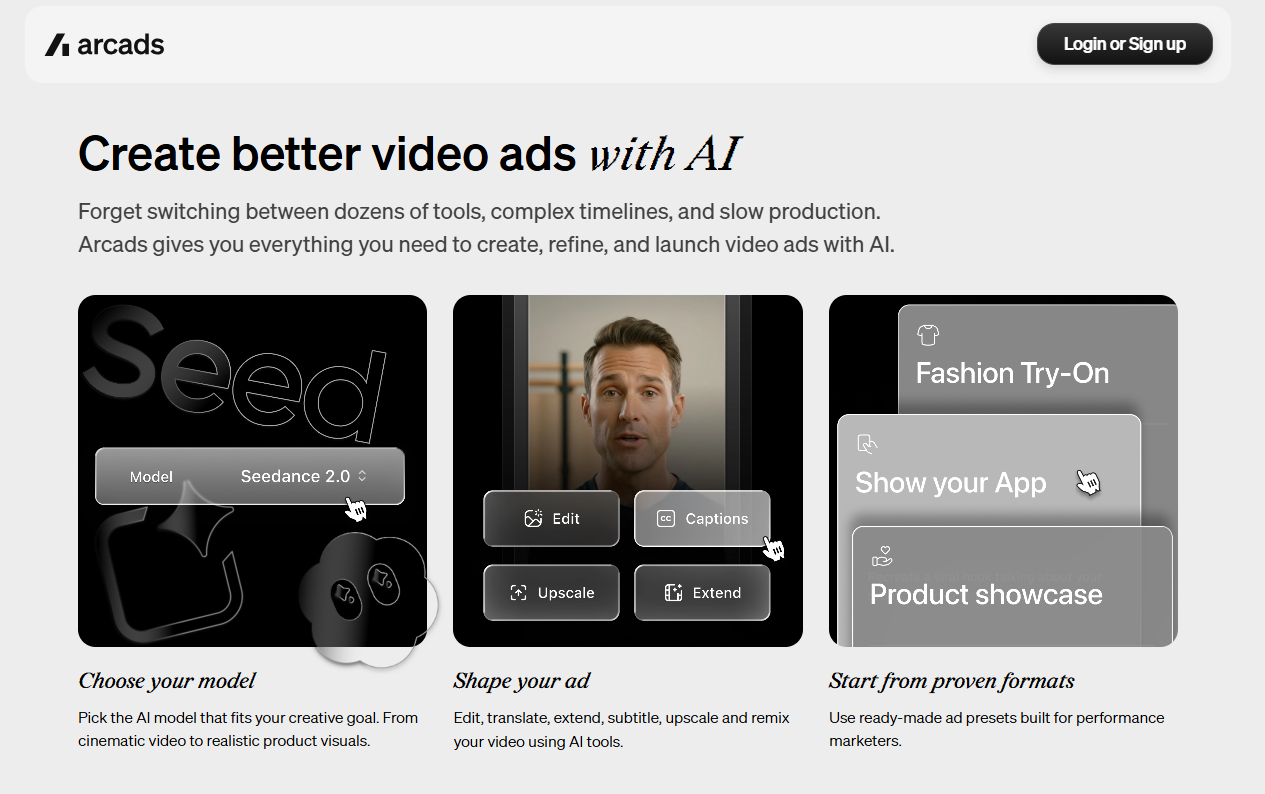
Tool Overview: A performance-ad platform centered on AI actors and presenter-style videos. Features include over 1,000 actor profiles reported by the vendor, custom actors, emotion controls, editing workflows, and translation features.
Key Pros: An AI actor library designed for talking-head and spokesperson-style creative; multilingual voice and translation features are available.
Limitations: Synthetic presenters cannot replace truthful product-in-hand demonstrations. Custom high-volume plans require sales onboarding.
Pricing: Structured across subscription tiers.
Our Pick For: Teams producing a high volume of spokesperson and problem-solution creative variants, particularly where talking-head presenter breadth is needed.
Tagshop AI
Tool Overview: An AI creative video platform that accepts a product URL, image, prompt, or creative brief and uses an AI Video Agent to build scripts, avatars, voices, scenes, captions, and b-roll.
Key Pros: Guided product-to-ad workflow; direct-response layout options designed for vertical social creative; review and unboxing formats.
Limitations: Claims and synthetic testimonial framing require human approval to maintain compliance with advertising standards.
Pricing: Official messaging includes tiered plans and custom team options.
Our Pick For: Ecommerce merchants seeking structured ad templates for unboxing and demonstration angles.
Shhots AI
Tool Overview: An ecommerce creative suite that turns product photos, URLs, or Shopify catalog inputs into dynamic video clips, cinematic ads, static ads, and product photography.
Key Pros: Strong product-image workflows; multiple social formats; useful when supplier images are the main available assets; commercial exports.
Limitations: Visual realism depends on source image quality. Credits and render options vary by plan.
Pricing: Pricing observed at the time of review: $19/month for the entry-level monthly Starter plan.
Our Pick For: Stores needing both polished product images and short product-centric motion ads from static assets.
HeyGen
Tool Overview: A broad AI video platform providing digital twins, advanced avatar rendering, voice cloning, video translation, and automated localization capabilities.
Key Pros: Strong avatar and translation capabilities; automated video translation with lip synchronization; business collaboration features.
Limitations: Less ecommerce-specific than dedicated URL-to-ad tools. Product assets, scripts, and demo cuts require manual assembly.
Pricing: Free trial available; paid tiers structured across Creator, Pro, and Enterprise levels.
Our Pick For: Localized spokesperson ads, product explainers, and retargeting campaigns across multiple international markets.
How to Create and Test Your First AI UGC Video Ad for Dropshipping (Step-by-Step)
Creating effective AI UGC video ads is more than pasting a product link into a tool. For dropshippers, the workflow should include product selection, clear creative angles, script development, synthetic-media review, advertising compliance checks, and structured performance testing before scaling spend.
1. Choose a Video-Friendly Product and Calculate Allowable CAC
Products with an easily demonstrated problem or benefit can be easier to communicate in short-form video, particularly when the core use case is visually understandable early in the creative:
- Visually Demonstrable Benefits: Items where primary utility can be shown through dynamic motion cuts within seconds.
- Low Reliance on Tactile Fit: Avoid items that depend heavily on complex physical fit, fabric drape, or intricate tactile feel unless you have authentic physical footage.
- Contribution Margin Discipline: Make sure the selling price leaves enough room to cover product cost, shipping, payment processing, discounts, refunds, operating expenses, and customer acquisition. Instead of relying on a universal markup percentage, calculate the maximum CAC your unit economics can support.
2. Gather and Structure Product Assets
AI generators can produce more consistent outputs when provided with clear, structured input data:
- High-Resolution Imagery: Clean supplier photos, transparent PNGs, and clear unboxing or functional video b-roll.
- Audience Pain Points: Review buyer inquiries and market feedback on platforms like TikTok Creative Center or Meta Ad Library to find natural phrasing.
- Offer Details: Define the actual bundle, discount, promotion terms, and delivery estimate supported by your current fulfillment route. Do not advertise a guaranteed delivery date unless you can reliably meet the stated commitment.
3. Build a Direct-Response Script Structure
Use this practical 30-second direct-response structure as an initial template (exact timing should be adjusted based on the product, platform, audience, and creative format):
- 0–3 Seconds (Visual & Verbal Hook): Capture attention with a relatable frustration, surprising application, or clear visual demonstration.
- 3–8 Seconds (Problem Articulation): Highlight the everyday annoyance or friction experienced without the product.
- 8–20 Seconds (Solution Demonstration): Introduce the product, showing fast-paced b-roll clips of its functional use in action.
- 20–25 Seconds (Benefits and Evidence): Highlight verifiable product benefits, demonstrations, specifications, or genuine customer evidence where available.
- 25–30 Seconds (Call to Action): Provide a clear verbal CTA and matching on-screen discount badge directing viewers to the store.
4. Generate Budget-Aligned Concept Variations
Avoid producing more variants than your budget can support with meaningful data. For mobile-first social placements, 9:16 is a common vertical format, but confirm the current specifications for each platform and placement. For initial tests, focus on several distinct angles rather than dozens of minor edits.
5. Audit Every Frame for Compliance and Truthfulness
Before committing ad spend, run a thorough human quality check:
- Visual Accuracy: Check for AI glitches (distorted hands, warped product logos, or unnatural facial movements).
- Product Truthfulness: Confirm that shown colors, dimensions, and accessories match what your supplier fulfills.
- Advertising Rules: Never present a synthetic avatar as a real customer, healthcare professional, or verified user when that representation is untrue. Avoid testimonials that imply personal product experience or professional qualifications that the presenter does not actually have. Avoid unsupported or exaggerated health or safety claims, and verify any regulated claims against applicable advertising requirements.
- Landing Page Congruence: Verify that advertised pricing, discount codes, shipping promises, and product variants match the live checkout.
6. Deploy Across Appropriate Channels
Choose the channel based on your audience, campaign objective, creative format, and measurement setup. TikTok Ads and Instagram Reels are natural environments for short-form vertical creative, while Meta Ads offers broad audience and retargeting options. YouTube Shorts can provide another distribution channel for vertical video. Check each platform's current advertising and measurement capabilities before launching.
7. Measure Funnel Metrics Using a Two-Stage Testing Model
Evaluate ad performance through quantitative data rather than personal visual taste, comparing results against your own historical baselines:
- 3-Second View Rate (where reported): Use this to assess how effectively the opening holds attention. Compare the result with your own historical baseline for similar campaigns, placements, audiences, and objectives.
- Outbound CTR: Measures the proportion of eligible impressions that result in an outbound click, and can help diagnose the combined effect of the hook, offer, creative-message fit, and audience targeting.
- Conversion Rate (CVR) & CPA: Helps determine whether post-click traffic converts at an acquisition cost that preserves target contribution profit. Evaluate CVR alongside traffic source, audience, product category, landing-page experience, and attribution settings.
Operational Note: Verify Fulfillment Capacity Before Increasing Spend
Before increasing your daily ad budget, coordinate with your fulfillment partner to confirm available inventory, processing capacity, shipping route, tracking coverage, and the current delivery estimate for the specific product and destination to reduce the risk of shipping bottlenecks, customer complaints, refunds, and payment or account issues.
How to Run AI UGC Videos: Free Organic Traffic vs. Paid Ads
Organic publishing is useful for low-cost hook testing. Post several distinct concepts, watch retention, comments, saves, profile visits, and product clicks, then remake the strongest angle. Keep a consistent niche and do not spam near-identical synthetic videos. Organic engagement should be treated as a directional signal rather than a direct proxy for paid conversion performance, but it can provide useful insights about customer objections.
Paid advertising provides controlled audiences, budgets, and conversion measurement, but amplifies mistakes quickly. Begin with small tests and separate audiences, offers, and creatives. Both Meta and TikTok have policies governing ads that use AI-generated or synthetic media. Requirements vary by content type, placement, and platform policy, so review current requirements before publishing. TikTok provides an AI-generated content disclaimer for applicable ads containing fully AI-generated or significantly modified media, while Meta may apply AI-related information labels to certain ads that use generative AI depending on how media is created or edited. Advertisers remain responsible for ensuring that material product claims are truthful and adequately substantiated where required.
Common Pitfalls to Avoid
While AI tools dramatically lower creative production barriers, misusing synthetic assets can lead to ad account restrictions, high refund rates, or wasted budget. Avoid these frequent pitfalls when launching AI-generated campaigns:
- Calling an AI avatar a real customer or inventing a testimonial.
- Showing product effects, texture, size, fit, packaging, or accessories that the real item does not have.
- Generating dozens of near-identical videos instead of testing meaningful hooks and offers.
- Copying supplier claims without substantiation or platform review.
- Ignoring the landing page, so price, variant, promise, and shipping information conflict with the ad.
- Scaling spend before confirming stock, processing capacity, tracking, returns, and customer support.
- Assuming an AI label makes deceptive content acceptable. Remember that an AI disclosure does not make an otherwise misleading claim acceptable; disclosure and truthfulness are separate legal obligations.
Maintaining rigorous creative compliance and offer consistency protects your ad accounts from policy flags and ensures that initial test winners can be scaled reliably.
Scaling Your Dropshipping Store with AI UGC Ads
Scale a product only after creative performance and order quality repeat across multiple tests. Build a creative matrix by hook, audience, objection, presenter, proof, and offer. Refresh the weakest element, preserve the winning message, and add real product footage or human creators when it improves trust. Localize only after a native reviewer checks language and market fit.
Connect the creative system to the supply chain. EPROLO provides product sourcing, quality control, custom packaging, fulfillment, tracking support, and warehouse options where available. Before raising spend, confirm the exact stock, route, processing time, and delivery promise. No supplier or ad tool can guarantee viral-scale performance, so keep spending and inventory thresholds that can be stopped safely.
Frequently Asked Questions
What is the main difference between AI UGC and traditional UGC?
Traditional UGC generally refers to content created by customers, users, or human creators, often based on real-world product use or creator-led production. AI UGC uses synthetic scripts, voices, avatars, imagery, or edits to imitate a creator-style format. It should not be presented as a genuine customer testimonial when no such experience exists.
How can a new store create video ads without customer reviews?
Use AI tools to draft problem-solution explainers, film your own real product demonstrations, hire freelance creators for selected physical concepts, and collect genuine post-purchase customer feedback over time. Do not invent fake reviews. Start with accurate product visuals and upgrade winning concepts with human proof.
What factors can improve the performance of an AI UGC video ad?
A clear opening visual hook, one relevant problem, believable product proof, an aligned offer and landing page, strong mobile pacing, audience fit, and dependable fulfillment. The AI tool mainly speeds production; it does not create product-market fit.
Do Meta and TikTok allow AI-generated video ads?
Both platforms support advertising that uses AI-generated media, subject to their current advertising, synthetic-media, disclosure, and other applicable policies. TikTok provides an AI-generated content disclaimer for applicable ads containing fully AI-generated or significantly modified media, and Meta may apply AI-related information labels to certain generative ads. Review current policy guidelines and ad settings before launching campaigns.
How do I fulfill orders quickly when an AI ad goes viral?
Pause or cap spend if stock and processing cannot keep up. Confirm available units, prioritize a reliable shipping route, synchronize tracking, prepare customer support, and consider pre-stocking inventory with a fulfillment partner like EPROLO. Always verify route-specific capacity and processing timing before scaling budgets.
Related Reading
- Best AI Tools for Dropshipping 2026 to Cut Costs Instantly
- How to Build a Dropshipping Website with AI Tools: A Step-by-Step Guide
- AI Dropshipping in 2026: How It Works, Tools, and Winning Strategy
- Top 13 Dropshipping Automation Software in 2026
- Building a Connected AI Dropshipping Workflow in 2026: From Market Research to Store Publishing
Written by
Josie
Josie is a skilled marketing specialist with expertise in TikTok, Facebook, and YouTube. She excels at audience growth and social media account management, consistently delivering valuable insights across key social marketing channels. Her strategic approach helps brands build meaningful engagement and expand their digital presence effectively.
Editorial note:
Editorial note: Software features, credit structures, and platform advertising policies change frequently. The evaluations provided here reflect operational criteria reviewed for 2026. Always confirm live subscription pricing, commercial licensing terms, regulatory compliance guidelines, and fulfillment capacity before scaling campaigns.