Finding digital product suppliers is harder than locating a folder of downloadable files. A reliable source must prove who owns the content, what you may edit or resell, and how buyers receive support. This guide explains how to source legal digital assets, verify licensing, test demand, and avoid low-quality bundles that trigger refunds or compliance problems.
Key Takeaways
- Verify Resale & Distribution Rights: A digital file is not resellable unless its license explicitly grants resale, editing, or commercial distribution permissions.
- Audit File Quality & Copyright Compliance: Mitigate refund risks and payment gateway holds by testing file usability, verifying creator authorship, and steering clear of anonymous PLR bundles.
- Build a Hybrid Catalog with EPROLO: Combine instant-download digital products with automated physical product fulfillment to increase Average Order Value (AOV) and customer retention.
Inside This Article
Challenges of finding digital product suppliers
A digital product supplier is not simply anyone who sells an e-book, template, preset, course, or software file. The source must explicitly grant the rights needed for your intended business model. A creator may sell an asset for the buyer's own use while prohibiting redistribution. A legitimate supplier or licensor provides written terms that explain whether resale, editing, rebranding, bundling, sublicensing, or commercial distribution is allowed.
Legal and copyright exposure
Unauthorized downloads can expose a store to copyright claims, marketplace takedowns, refunds, chargebacks, and payment-account reviews. Stripe's restricted-business rules prohibit products or services that directly infringe or facilitate infringement of third-party intellectual property. PayPal's terms require users to own or control the necessary rights and permit account limitations or other action under its policies. A processor freeze is not automatic for every digital product, but unclear ownership, repeated complaints, prohibited content, or infringement allegations can put access to payments at risk.
Quality-control problems
Cheap private-label-rights packs often contain outdated screenshots, broken links, repetitive AI-written passages, low-resolution graphics, or information already available for free. Customers can identify generic material quickly, especially when identical files appear in many stores. The result can be immediate refund requests, poor reviews, support tickets, and low trust. Open every file, proofread the content, test editable elements, scan links, verify software compatibility, and compare the claims with current sources before publishing.
Digital licensors versus physical supplier directories
Physical supplier directories focus on inventory, unit costs, samples, manufacturing, packaging, delivery times, and tracking. Digital sourcing replaces those logistics checks with an intellectual-property and file-quality audit. The essential records are the license, chain of ownership, permitted sales channels, modification rights, update policy, file specifications, and support terms. Traditional supplier metrics still matter when a store later adds physical merchandise, but they do not prove that a downloadable asset is legal to redistribute.
Where to find digital product suppliers
When researching how to find digital dropshipping products, begin with sources that publish clear licensing documents and identify the original creator or rights holder. Never assume that buying a file creates resale rights. A normal end-user purchase usually permits use of the asset, not redistribution of the original or editable source file.
Private Label Rights databases
PLR databases can provide e-books, worksheets, templates, graphics, videos, and course materials that may be editable and resellable. The word “PLR” is only a category label. One license may permit full rebranding, while another may prohibit marketplace sales, source-file distribution, low-price offers, or transfer of rights to customers. Favor providers that show a dated license before checkout, identify the author, provide previews, document updates, and issue an invoice or license certificate tied to the purchased product.
Independent creator licensing
A direct commercial reseller agreement with a creator, studio, educator, or software developer can produce a more distinctive catalog. Define the product, territory, sales channels, term, exclusivity, modification rights, support duties, update access, refund responsibility, royalty or flat fee, and termination process in writing. Ask the creator to warrant that the work is original or properly licensed. For meaningful revenue or complex rights, have qualified legal counsel review the agreement.
Specialized B2B licensing networks
Some B2B networks connect retailers with content studios, training providers, software vendors, or white-label service companies. Evaluate them as licensing networks rather than conventional product directories. Ask whether the platform verifies authorship, keeps historical license versions, mediates disputes, and removes infringing uploads. A large catalog is less valuable than traceable rights and responsive support.
| Source type | Typical role | Critical verification |
|---|---|---|
| Creator or marketplace seller | Sells original assets mainly to end users | Do not resell unless a separate license explicitly permits it |
| PLR or MRR provider | Offers defined editing or resale rights | Read product-specific restrictions and retain proof |
| Direct licensor | Negotiates customized distribution rights | Use a signed agreement covering ownership and permitted uses |
| Physical supplier platform | Sources, packs, and ships tangible goods | Evaluate product quality, fulfillment, branding, and logistics |
How to find trending digital products
A trend is useful only when it connects to a buyer problem that your licensed product can solve. Use several signals and separate attention from purchase intent. Views and saves show interest; searches, email signups, checkout starts, and completed purchases provide stronger evidence.
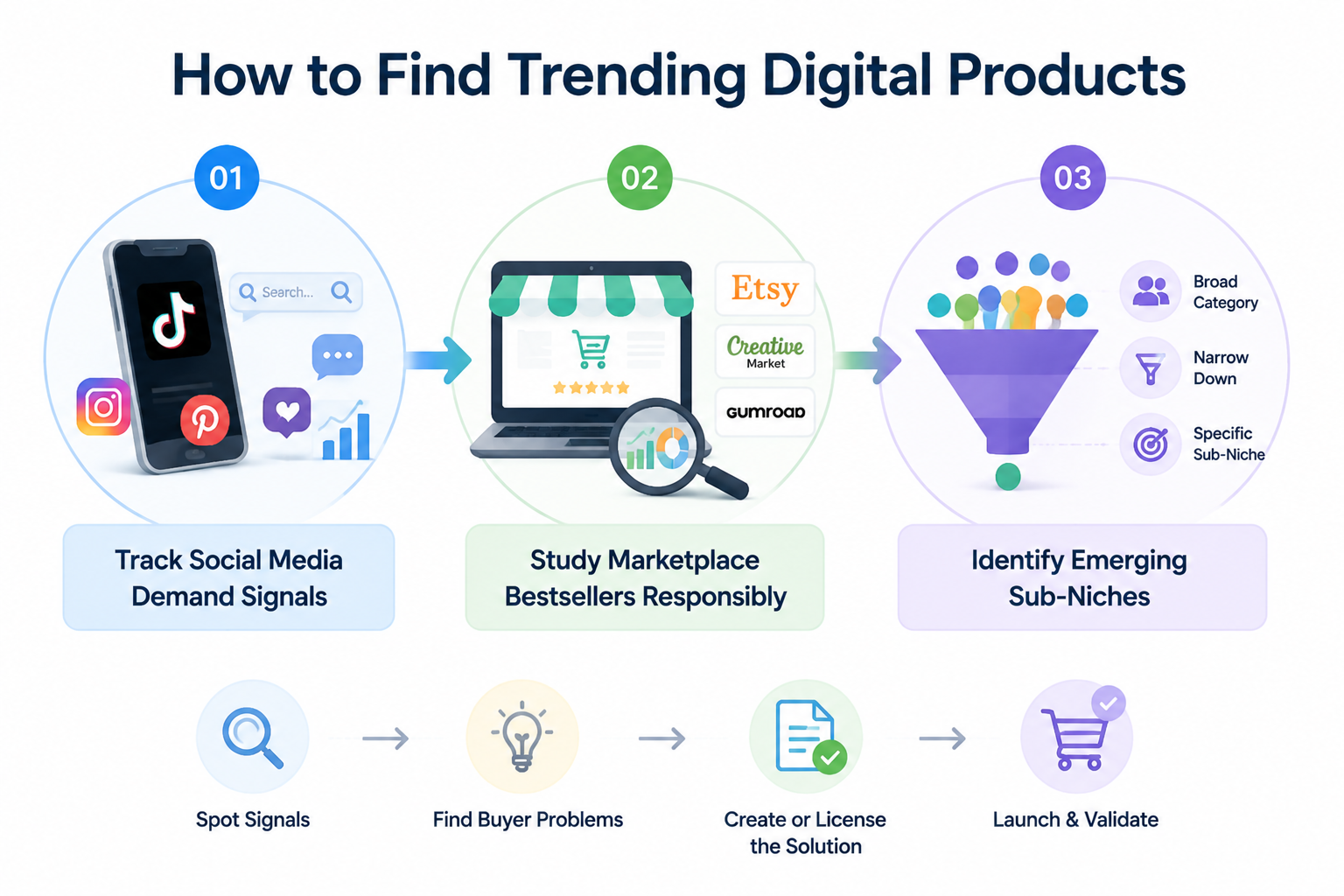
Track social media demand signals
Use TikTok search suggestions and recent-result filters to study repeated questions, tutorial formats, and comments that reveal unfinished tasks. Review Instagram Reels engagement for saves, shares, and specific questions rather than raw views alone. Pinterest trend boards and search suggestions can reveal seasonal planning behavior and visual styles. Record the buyer problem, audience, format, and timing. Do not download, copy, or imitate another creator's actual files, branding, scripts, or artwork.
Study marketplace bestsellers responsibly
Etsy, Creative Market, and Gumroad can reveal active categories, price ranges, bundle sizes, preview conventions, and recurring review themes. Look for patterns, not products to duplicate. Creative Market's license guidance, for example, states that purchased source items generally cannot be included in distributed end products. Use bestseller research to identify unmet needs such as clearer instructions, better localization, accessibility, newer formats, or stronger support. Then create an original product or obtain a license designed for resale.
Identify emerging sub-niches
Broad categories such as “AI prompts” or “business templates” are crowded. Narrow the offer around a job, workflow, platform, experience level, or region. “AI prompts for ecommerce copywriters auditing product pages” is more specific than a general prompt bundle. Other possibilities include bilingual onboarding templates for freelance designers, sensory-friendly classroom printables, or spreadsheet systems for small event vendors. Validate that the sub-niche has a recurring problem and enough buyers before licensing a large catalog.
How to check digital product licensing
License names are not standardized across every supplier. Treat the actual agreement as the source of truth and save the version that applied on the purchase date. If the language is ambiguous, ask the rights holder for written clarification before listing the product.
Understand PLR, MRR, and commercial-use rights
- Private Label Rights (PLR): may allow editing, rebranding, and resale, but the exact permissions and restrictions vary by product.
- Master Resell Rights (MRR): may permit resale and, in some agreements, permission for your buyers to resell. Confirm whether rights can actually be passed onward.
- Commercial-use rights: often allow an asset to be used in business or in a finished product. They do not automatically permit resale of the original file, source asset, or editable template.
Use a rights audit checklist
Confirm whether you may modify text and visuals, remove the original brand, sell the source file, create bundles, offer subscriptions, distribute through marketplaces, translate the material, use included trademarks, and transfer any rights to customers. Check geographic limits, minimum or maximum prices, non-compete clauses, attribution rules, prohibited niches, sales-volume caps, and license termination terms. Keep the invoice, license, product page, correspondence, and identity of the licensor in one compliance folder.
Recognize licensing red flags
Avoid anonymous download folders, torrent sites, shared cloud drives with no invoice, and enormous asset bundles that contain famous brands or inconsistent creator names. Other warnings include copied marketplace previews, missing terms, a seller who refuses to identify the author, impossible exclusivity claims, and licenses that can be changed without preserving prior versions. Reverse-search sample images, inspect file metadata, and ask for proof of authorship or a documented licensing chain.
Compliance principle: “I paid for the file” is not the same as “I have the right to redistribute the file.” Your records should show the specific permission that supports each listing.
AI-assisted digital products & copyright considerations
Copyright protection for AI-assisted digital products depends heavily on the extent and nature of human creative contribution. In the United States and some other jurisdictions, copyright protection generally focuses on whether sufficient human authorship exists in the final work. When sourcing AI-assisted prompts, templates, or ebooks, merchants should review the creator's licensing terms and confirm what commercial rights are included to improve originality, commercial differentiation, and compliance confidence.
Note: For jurisdiction-specific legal boundaries, refer to official copyright office publications and applicable intellectual property regulations in your target market.
How to source and list digital products
Step 1: Select a vetted supplier and license the files
Start with one focused asset instead of purchasing hundreds of files. Review the supplier's business identity, license, refund terms, support channel, file previews, and customer history. Buy through a traceable payment method and save all documentation. Open every component and confirm that the promised formats are present, editable, current, malware-free, and suitable for the target audience.
Step 2: Rebrand only within the license
If modification is permitted, improve the asset rather than changing only the cover. Update facts, rewrite weak passages, add original examples, localize terminology, improve accessibility, and create a coherent visual system. Produce custom mockups that accurately show the buyer what is included. Do not use supplier previews, trademarks, fonts, photos, or design elements beyond their licensed scope.
Step 3: Configure automated file delivery
Shopify requires an app to provide digital download links, and its Digital Products app can send files or supported links after payment. WooCommerce supports downloadable products and offers delivery settings such as protected methods, download limits, and customer-account access. Configure the correct tax and fulfillment settings for your jurisdiction, protect the source file, customize the delivery email, and ensure mixed digital and physical orders follow separate fulfillment paths.
Step 4: Set value-driven pricing
Price the outcome, quality, rights, support, and differentiation rather than the file size. A single purchase is simple for first-time buyers. A bundle can raise Average Order Value when every component supports the same goal. Premium tiers may include extended use, updates, onboarding, or additional formats if the upstream license permits them. Account for processor fees, platform costs, taxes, advertising, refunds, support, and update labor before calling the margin attractive.
Step 5: Test the complete purchasing loop
Place real test orders on desktop and mobile with different email providers. Confirm successful payment, immediate delivery, correct filenames, working passwords, download limits, readable instructions, customer-account access, and refund handling. Test a failed payment to ensure it does not release the asset. For mixed orders, verify that the digital file arrives without waiting for the physical parcel and that shipping notifications remain clear.
Combining digital products with EPROLO Automated Fulfillment
Digital products can deliver quickly and support strong gross margins, but many are one-time purchases. A customer rarely needs the identical planner, template, or guide twice. Updates, memberships, and new editions can improve retention, yet some merchants eventually add complementary physical products to create gifting, replenishment, bundling, and repeat-purchase opportunities.
EPROLO is designed for the physical side of that hybrid model. Its official site describes product sourcing, store and order synchronization, quality checks, packaging, global shipping, and parcel tracking. Eligible branding services include custom labels, hangtags, and packaging with no MOQ options, although product eligibility, service charges, shipping costs, and customization terms should be confirmed before making customer promises.
For example, a store could sell a licensed home-workout planner through a Shopify or WooCommerce digital-delivery workflow and add relevant physical fitness accessories sourced through EPROLO. The buyer receives the file from the store's digital app, while EPROLO processes the applicable physical order. This separation keeps each fulfillment path clear.
EPROLO should not be presented as a supplier or delivery system for e-books, templates, software, course access, or other downloads. Its value in this context is helping a digital-first merchant expand into physical goods without buying bulk inventory or operating an in-house warehouse. Samples, category rules, branding eligibility, and delivery performance should still be evaluated for every physical product.
| Store component | Recommended fulfillment path | Primary control |
|---|---|---|
| Digital guide, template, or file | Shopify digital app or WooCommerce downloadable product | License, protected access, file quality, and delivery test |
| Complementary physical product | EPROLO sourcing and automated physical fulfillment | Sample quality, cost, branding, packaging, shipping, and tracking |
| Mixed customer order | Separate digital and physical fulfillment rules | Clear confirmation emails, delivery timing, and support ownership |
Digital supplier verification checklist
Use the following audit before paying a supplier or publishing a listing. Record evidence, not just a pass or fail. A screenshot of a license page is helpful, but a dated invoice, downloadable license, signed agreement, and written clarification provide a stronger trail.
| Audit area | What to verify | Evidence to retain | Red flag |
|---|---|---|---|
| License documentation | Resale, editing, rebranding, marketplace, transfer, and geographic rights | Dated license, invoice, product URL, and supplier correspondence | “Unlimited rights” with no written terms |
| File-format quality | Files open, edit, print, or install as promised and contain current information | Test notes, version numbers, screenshots, and malware scan | Broken, locked, low-resolution, or mislabeled files |
| Download performance | Reasonable speed, reliable hosting, correct passwords, and backup access | Test-order timestamps and delivery screenshots | Public shared folder or frequently expired link |
| Customer support | Response time, update policy, technical assistance, and dispute contact | Pre-sale question and written response | No identifiable business or support channel |
| Payment compliance | Clear ownership, accurate claims, refund terms, privacy, and prohibited-content screening | Rights folder, policies, product proof, and complaint log | Copied brands, anonymous authors, or repeated infringement complaints |
After supplier approval, document the operating workflow: who updates the digital file, who answers technical questions, which system delivers it, and which platform fulfills any physical add-on. Clear automation reduces manual errors, but it does not replace licensing review or customer support.
FAQ About Digital Product Suppliers
How do I find reliable digital product suppliers?
Look for a verifiable business or creator identity, product-specific license terms, proof of authorship, detailed previews, traceable payment records, and responsive support. Purchase one product first, inspect every file, test delivery, and ask written questions about resale, editing, marketplaces, and rights transfer. Avoid anonymous folders and suppliers that rely only on labels such as PLR or MRR without a complete agreement.
How do I know if a digital product is trending?
Combine social search activity, marketplace category movement, review themes, search suggestions, keyword trends, and direct customer questions. Then validate with a landing page, waitlist, preview content, checkout test, or small paid campaign. Saves and views are useful early signals, but signups, checkout starts, and purchases provide stronger evidence that a trend can support a business.
Is dropshipping digital products legal?
Yes, reselling or dropshipping digital products is legal provided you hold an active license, commercial reseller agreement, or written permission from the original intellectual property owner. Selling copyright-protected digital assets without explicit distribution rights is illegal and can lead to immediate payment processor suspensions or legal claims.
Are PLR (Private Label Rights) products safe to sell?
PLR products are safe only when sourced from reputable suppliers that provide dated invoices and explicit licensing contracts. To avoid duplicate content penalties and customer refund claims, always edit, rebrand, and add original value to PLR assets before publishing them to your store.
Can I customize digital assets from suppliers before selling them?
Only when the specific license allows modification and resale. Some PLR agreements permit editing and rebranding, while commercial-use licenses may allow an asset inside a finished product but prohibit redistribution of the original source file. Confirm permitted changes, trademarks, included third-party assets, marketplace rules, attribution, and whether your customers receive any rights. Keep written proof before publishing the customized product.
Related reading
- How to Avoid White Label Dropshipping Risks in 2026
- Ultimate Guide to White Label Dropshipping Packaging in 2026: Build Trust With Zero Inventory
- Best Ecommerce Fulfillment Solutions for 2026
- Best Warehousing and Fulfillment Services in 2026
- Top Private Label Clothing Dropshipping Suppliers - White Label (2026 Update)
Written by
Inverse
Inverse is a skilled Google SEO operations expert , with deep expertise in technical site audits, content clustering, and keyword strategy. Excelling at search engine visibility and organic traffic optimization, Inverse consistently delivers actionable insights across key search channels. This strategic approach helps e-commerce brands build sustainable organic traffic and expand their digital footprint effectively.
Editorial note:
Editorial note: Licensing and platform-policy information was checked against official materials available during preparation. License terms, payment rules, ecommerce app features, and EPROLO service eligibility can change. This article provides operational information, not legal or tax advice. Review the current agreement for each product and obtain qualified professional advice when necessary.