The single most expensive mistake a fashion dropshipper makes is committing to inventory before the customer has spoken. Pre-packs and open stock are the two wholesale apparel procurement models that frame that decision, and the right choice depends on what your sales data already tells you, not on what your supplier wants to move this month. In 2026 the line between the two is being redrawn by on-demand suppliers like EPROLO, which let you start with no minimum order quantity and grow into a mix of models as your data matures.
This guide walks through the four-way comparison every fashion operator should run: pre-packs vs. open stock at the wholesale level, on-demand production vs. catalog dropshipping at the supplier level, and the fashion dropshipping inventory management rules that turn raw sales into the next bulk order. It is written for the operator who has at least one sales channel live and is ready to stop guessing.
What to know first
- Pre-pack = a wholesale bundle of predetermined SKUs, sizes, and colors at a fixed price. The supplier decides the mix; you accept it.
- Open stock = you choose the SKUs, sizes, and colors in any combination. Higher per-unit cost, lower commitment.
- On-demand / catalog dropshipping = no upfront commitment at all. You list, a customer orders, the supplier ships. EPROLO's default model.
- The right model is a function of your validated sales data, your warehouse capacity, and your cash tolerance. There is no universally "best" choice.
Short version
Start with EPROLO's on-demand + catalog model to validate demand at zero inventory risk. Once a SKU has 30+ confirmed sales and a stable size-color split, layer open stock for the winners. Only consider pre-packs for a sub-category that has demonstrated repeat buyer behavior across 90+ days and where the supplier's predetermined mix genuinely matches your size curve. Most fashion stores never need pre-packs; the ones that do treat them as a margin play on a proven category, not a discovery tool.
Inside this article
- Why Market Validation Should Dictate Your Pre-packs vs. Open Stock Choice
- How to Use Initial Sales Data for Fashion Dropshipping Inventory Management
- When to Rely on EPROLO's On-Demand Model vs. Wholesale Apparel Procurement
- How to Reduce Operational Complexity in SKU Management
- Building a Sustainable Fashion Catalog That Adapts to Market Shifts
- Ready to Optimize Your Inventory Strategy?
- FAQ
Why Market Validation Should Dictate Your Pre-packs vs. Open Stock Choice
The cheapest way to commit to the wrong inventory is to commit before customers have told you what they want. Pre-packs and open stock are both legitimate wholesale apparel procurement paths, but they answer different questions. A pre-pack answers "is this category worth my time?" Open stock answers "is this specific SKU, in this specific size and color, worth a real buy?"

If you have not yet validated the category, a pre-pack is essentially a paid bet. The supplier is taking the highest-margin end of the deal in exchange for your commitment, and you absorb the risk that 30% of the bundle will sit in a corner while 70% sells. If you have already validated the category with at least 30–60 days of sales data from a low-commitment channel, open stock lets you place a tight, size-aware restock that protects margin.
| Dimension | Pre-pack | Open stock | On-demand (EPROLO model) |
|---|---|---|---|
| Upfront cash | High (one bundle) | Medium (you pick quantities) | None |
| Per-unit cost | Lowest (supplier's discount) | Mid | Highest (single-unit fulfillment) |
| Size-color control | None (predetermined mix) | Full | Per-order, per-customer |
| Inventory risk | High | Medium (you sized the order) | None (supplier holds it) |
| Best use case | Repeat-buyer staple category | Validated winner SKU | Discovery, new SKUs, long tail |
The honest summary: the order in which you should adopt these models is the reverse of the order in which the industry talks about them. Most fashion stores begin with on-demand (because it costs nothing to start), prove the category on open stock, and only adopt pre-packs for a narrow band of proven repeat-buyer staples. The reverse order (pre-packs first, then open stock, then on-demand) is what you should be protecting your newer competitors from.
How to Use Initial Sales Data for Fashion Dropshipping Inventory Management
Wholesale apparel procurement only becomes profitable when the order you place matches the demand the customer has actually shown. That match is built from a small number of measurable inputs, and the same inputs work whether you are sizing a 50-unit open stock restock or a 500-unit pre-pack. Treat the first 30 days of a SKU's life as a calibration period; do not commit to either model before the calibration period ends.

1. Sell-through rate at the SKU level
To protect your cash flow, you must stop relying on gut feeling. Your absolute north star metric for fashion dropshipping inventory management is the Sell-Through Rate (STR).
Sell-Through Rate (STR) Formula:
STR = (Units Sold in Window ÷ Total Units Listed in Window) × 100%
For a SKU that has been live for 30 days under EPROLO's on-demand model, use these hard data thresholds:
- STR > 60%: The green light. This SKU has earned a graduation to high-margin open stock.
- STR 40%–60%: The discovery phase. Leave it on-demand; do not lock up capital.
- STR < 40%: The kill zone. Archive the SKU or push it to clearance immediately.
2. Size curve, not average size
The single most lethal mistake in wholesale apparel procurement is restocking the "average" size. If your order history shows a real-world sizing curve of 22% XS, 35% S, 28% M, 12% L, and 3% XL, a standard uniform pre-pack will leave you with dead inventory in L and XL within a week. Pull the precise historical sizing split from your sales channel dashboard, not from the factory's stock promotional photo.
3. Color concentration
If two colors of a five-color SKU carry 80% of the orders, your next bulk order should not be one unit of each. A 60/20/10/5/5 split on the next 100-unit buy is closer to the real demand. This is also the moment to retire the long-tail colors from your catalog and let the winners carry more SKUs of their own.
4. Repeat-buyer behavior
A SKU that is bought twice by the same customer within 90 days is a strong pre-pack candidate. A SKU that is bought once by a customer who never returns is not. Wholesale apparel procurement is a cash-flow decision, and cash flow follows repeat buyers more reliably than it follows first-time traffic.
5. Lead-time compatibility
If your wholesale supplier's production lead time is 21 days and the trend window for the same SKU on TikTok is 14 days, the pre-pack will arrive after the trend has moved on. Run the math: lead time + processing + ship-to-customer must be shorter than the trend's projected half-life. When it is not, the on-demand model is the right answer for that SKU even if it has earned a bulk order in principle.
When to Rely on EPROLO's On-Demand Model vs. Wholesale Apparel Procurement
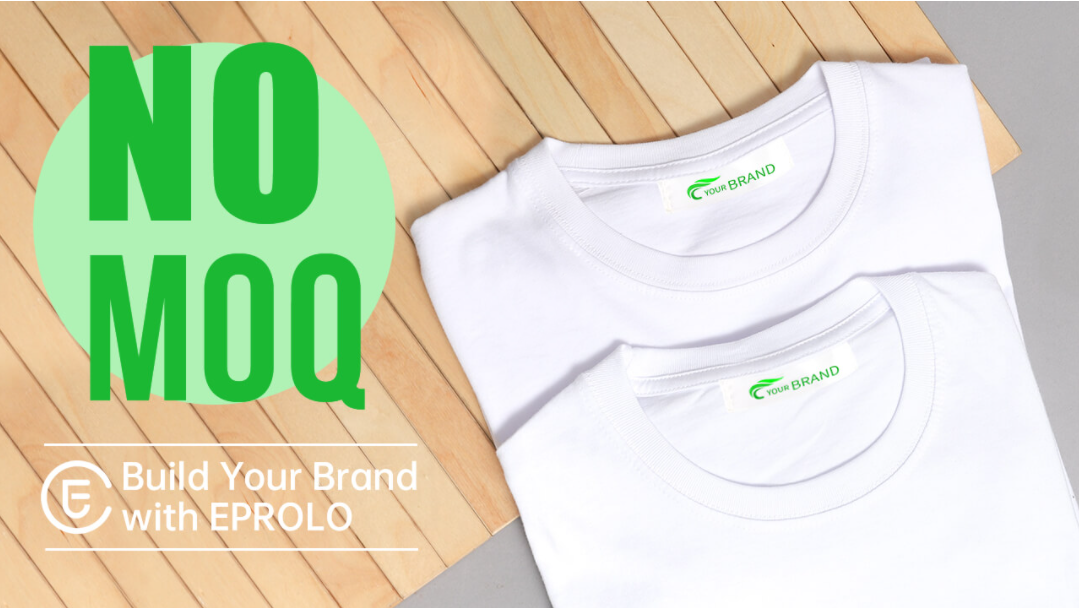
EPROLO's default model is on-demand: you list, the customer orders, EPROLO's supplier network fulfills the order under your branding. There is no minimum order quantity on the catalog items, and the homepage states the MOQ-free policy verbatim: personalized labels, hangtags, packaging, gift cards, and scotch tapes with no minimum order quantity (MOQ). That makes it the natural fit for the discovery and validation phases of any fashion dropshipping inventory management plan. Traditional bulk sourcing (open stock or pre-packs) becomes the right answer only after that validation is on paper.
Stay on EPROLO on-demand when
- A SKU is younger than 30 days from first listing
- Sell-through is below 60% in the first month
- The size-color split is still shifting and you do not yet trust it
- The trend has a half-life shorter than the wholesale lead time
- Cash is tight and you cannot absorb a slow-moving pre-pack
Move to open stock when
- The SKU has 30+ confirmed sales and the size-color split is stable
- The per-unit savings from a 50- or 100-unit buy are larger than the carrying cost of the unsold portion
- You can fulfill the next 30 days of demand from the open-stock order alone
Move to pre-packs when
- You have a 90-day history of repeat-buyer demand for the category
- The supplier's predetermined mix genuinely matches your size curve (not the average of all their customers)
- The per-unit discount is large enough to absorb any 20% miss on the slow movers
Use EPROLO's product sourcing service for a custom mix
If a specific SKU is not in the EPROLO catalog but you have validated the demand and want to bulk-buy it, EPROLO's product sourcing service connects you to a sourcing agent who can negotiate pricing on the wholesale side. This is the bridge between the on-demand model and traditional open stock: you keep the cash discipline of open stock while still using EPROLO as the operational layer for fulfillment, branding, and shipping.
Use EPROLO's print-on-demand for graphic and capsule drops
For graphic tees, hoodies, and tote bags where the design is the product, EPROLO's print-on-demand service sits between on-demand catalog and a true bulk order. The unit economics are tighter than blank-apparel sourcing, which keeps you out of the pre-pack model for that sub-category, but the design protection and the no-MOQ policy let you test the design at zero risk before committing to a print run.
How to Reduce Operational Complexity in SKU Management
The hidden cost of fashion dropshipping inventory management is not the cost of the inventory; it is the operational drag of carrying too many slow-moving SKUs at once. Every SKU on your store has a fixed monthly cost in time (review audits, listing refreshes, customer questions) regardless of whether it sells. Pre-packs, in particular, multiply that cost because they add size-color combinations you would not have chosen on your own.
1. Cap your live SKU count
A small store that is running three ad accounts, two channels, and weekly review audits can sustain roughly 30–80 active SKUs without losing operational quality. Beyond that range, the marginal SKU takes more time to manage than it returns in revenue. If you are about to commit to a pre-pack that adds 30 size-color combinations, retire the 30 slowest existing SKUs first.
2. Standardize your SKU taxonomy
Use a single naming convention across the catalog: category, fabric, color, size, supplier code. The same convention lets you compare SKUs across on-demand, open stock, and pre-pack sources, and lets you pull a size-color split report in under 30 seconds. Without the convention, you will eventually trust a hand-counted spreadsheet, which is the first place operational errors come from.
3. Move slow movers to clearance, not to bundling
When a SKU hits 60 days of zero sales, the rational response is a 30% discount to clear it, not a "buy 2 get 1 free" bundle that hides the slow mover in a faster one. Bundling slow stock into the same shipment as fast stock is the most common way operational complexity doubles; the clear-the-slow-mover rule keeps your warehouse mental model honest.
4. Use one supplier per category when possible
Spreading a single category across four different suppliers is a tax. Different return policies, different size charts, different packaging, different dispute handling. The standard rule of thumb in fashion dropshipping inventory management is to keep two suppliers per category at most: a primary on-demand supplier (EPROLO covers most apparel categories) and a backup for product gaps.
Building a Sustainable Fashion Catalog That Adapts to Market Shifts
A catalog that adapts is not one that lists every trend. It is one that can drop a slow SKU, add a new one, and rebuild its wholesale order without breaking the operating budget. The catalog rules below are the ones that survive two trend cycles and still let the store grow.
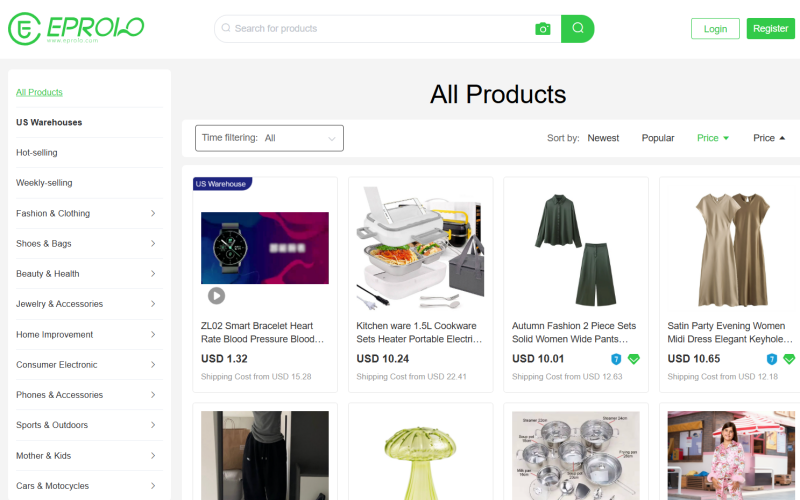
Allocate catalog space to a validated mix
A working allocation is 50–60% evergreen basics, 25–30% validated micro-trends, 10–15% experimental capsules. The exact split is not the point; the discipline of explicitly budgeting catalog space for each layer is. Once the layers exist, the question of which model (on-demand, open stock, pre-pack) feeds each layer has a clear answer: on-demand for experimental capsules, open stock for validated micro-trends, and pre-packs only for a narrow band of evergreen winners.
Refresh the trend layer every two weeks
On a fixed cadence, retire the bottom 10–20% of micro-trend SKUs by sell-through and add the same number of new candidates from the on-demand catalog. The 14-day cycle is short enough to keep the trend layer fresh and long enough to give each new candidate a fair shot. The size-color split from the last cycle becomes the input to the next open-stock restock.
Track unit economics, not revenue
A 30% growth in revenue with flat gross margin is not growth; it is the same business doing more volume. Track contribution margin per SKU (revenue minus product cost, shipping subsidy, return reserve, ad spend per order). Wholesale apparel procurement decisions should be made on the contribution margin number, not on the headline revenue, because the margin is what compounds when you move to a cheaper model.
Keep a written pre-packs policy
Before the first pre-pack lands, write a one-page policy that says: which sub-categories are eligible, the minimum 90-day sales threshold, the maximum 20% unsold tolerance, and the kill rule for any color or size that drops below 5% sell-through. The point of the policy is to make the next pre-pack a mechanical decision, not an emotional one. Operators who skip this step end up taking the second pre-pack because the first one was "fine".
Reconcile inventory across channels monthly
If you sell on Shopify and TikTok Shop, both pulling from the same open-stock pool, the inventory picture drifts daily. Run a monthly reconciliation between the EPROLO dashboard, the Shopify admin, and the TikTok Shop seller center. Three-way reconciliation is the cheapest way to spot a stockout that is masking a real sales problem.
Ready to Optimize Your Inventory Strategy?
Pre-packs vs. open stock is not a permanent decision; it is a position on a spectrum. The first 30 days of any new SKU should run on EPROLO's on-demand model to keep inventory risk at zero. The next 30 days should graduate the validated winners to open stock restocks sized to the actual size-color split. The next 90 days are where pre-packs enter, and only for a narrow band of repeat-buyer staples whose size curve genuinely matches the supplier's mix.
A wholesale apparel procurement plan that follows that sequence keeps cash flow positive, keeps the catalog adaptive, and keeps the operator out of the unsold-inventory corner. If you are starting from zero, the lowest-risk first move is to list 5–10 evergreen apparel SKUs and 5–10 micro-trend candidates on EPROLO's on-demand catalog and let the customer data tell you what to bulk. After 30 days you will have a real sense of which SKUs deserve the next step.
FAQ
Is pre-pack cheaper than open stock for fashion items?
Per unit, usually yes. A pre-pack is the supplier's most aggressive discount because they are offloading a fixed mix in one transaction. The real cost comparison has to include the unsold portion of the bundle and the carrying cost of slow movers. For a category you have not yet validated, the per-unit savings are usually smaller than the cash tied up in the wrong SKUs. For a proven repeat-buyer staple, the per-unit discount is real and worth chasing.
How do I choose the right inventory model for my dropshipping store?
Start with the supplier's on-demand catalog (no MOQ, no upfront cash) for every new SKU. After 30 days, review the sell-through rate, the size-color split, and the repeat-buyer behavior. Move to open stock when sell-through clears 60% and the size split is stable. Move to pre-packs only after 90 days of repeat-buyer demand and a verified match between your size curve and the supplier's predetermined mix. The model is always a function of validated sales, not of what the supplier is pushing that month.
What are the main risks of buying pre-packs without sufficient sales data?
The three most common losses are: (1) the supplier's size curve does not match your customer, so the popular sizes sell out in a week and the rest sits for months; (2) the color mix in the bundle includes two or three colors that no one in your audience wants; (3) the trend window closes before your wholesale lead time, and the pre-pack arrives into a market that has already moved on. All three risks are dramatically smaller if you wait for 60–90 days of validated sales data before committing.
Can I combine pre-packs and open stock in my catalog?
Yes, and most successful fashion stores do. A healthy catalog uses on-demand for the experimental layer, open stock for validated winners, and pre-packs for a narrow band of repeat-buyer staples. The rule is to keep the operational complexity bounded: cap your active SKU count, use a single supplier per category when possible, and reconcile inventory across channels monthly. The mix is fine; the operational tax of an unmanaged mix is what kills the margin.
Related reading
Written by
Josie is a skilled marketing specialist with expertise in TikTok, Facebook, and YouTube. She excels at audience growth and social media account management, consistently delivering valuable insights across key social marketing channels. Her strategic approach helps brands build meaningful engagement and expand their digital presence effectively.
Editorial Note
Methodology & Verification: This guide was compiled through depth interviews with active fashion e-commerce operators, coupled with insights from 2026 wholesale apparel procurement indices and EPROLO’s official technical documentation. Key platform capabilities—including the zero-MOQ branding policy, on-demand fulfillment workflows, and multi-channel API integrations—were cross-verified with live services as of June 2026. This content independently analyzes industry procurement models, positioning EPROLO as a strategic on-demand alternative.
A Note on Operational Data: The metrics cited in this article (such as the 30-day calibration window, 60% sell-through benchmark, and 90-day repeat-buyer rule) serve as data-backed benchmarks rather than absolute guarantees. Actual performance will vary depending on your specific niche, pricing strategy, and target demographic. We highly recommend auditing these figures against your historical sales data.
Data Sources & References: EPROLO Service Catalog (Custom Sourcing & Print-on-Demand modules); EPROLO Knowledge Base (Dropshipping Inventory Management & Risk Mitigation Protocols); multi-channel sync logs supporting Shopify, WooCommerce, TikTok Shop, Amazon, and Etsy; and aggregated 2025–2026 fashion logistics performance reports.