To start dropshipping with Shoplazza in 2026, you need more than a store theme and a trending product. In practice, building a sustainable Shoplazza store depends less on storefront design and more on supplier reliability, landed cost control, payment gateway compliance, and fulfillment accuracy.
Before launching, verify key operational factors including platform cost, supplier connection, shipping rules, automation capabilities, and long-term scalability. Use the sections below to evaluate these core details and test your full fulfillment workflow with a sample purchase.
Key Takeaways
- Shoplazza is free to test for seven days, but continued selling requires a paid plan.
- The platform is legitimate; payment eligibility and customer trust still depend on merchant compliance and fulfillment performance.
- Supplier quality, landed cost, shipping routes, and sample orders matter more than catalog size.
- EPROLO can connect product importing, order synchronization, fulfillment, and tracking with Shoplazza.
- Shopify offers a broader ecosystem, while Shoplazza may suit sellers who prefer a more consolidated cross-border workflow.
Inside This Article
Is Shoplazza Free? What Does It Actually Cost Per Month?
Shoplazza is free to test, not free to operate indefinitely. Its current pricing page offers an instant AI store preview and a seven-day platform trial. After the trial, a paid subscription is required to keep the store active and selling.
| Plan | Monthly billing | Annual equivalent | Listed transaction fee | Best fit |
|---|---|---|---|---|
| Basic | $39/month | $29.25/month, billed annually | 2% | Solopreneurs and new dropshippers |
| Advanced | $105/month | $78.75/month, billed annually | 1% | Growing stores |
| Pro | $399/month | $299.25/month, billed annually | 0.5% | High-volume merchants |
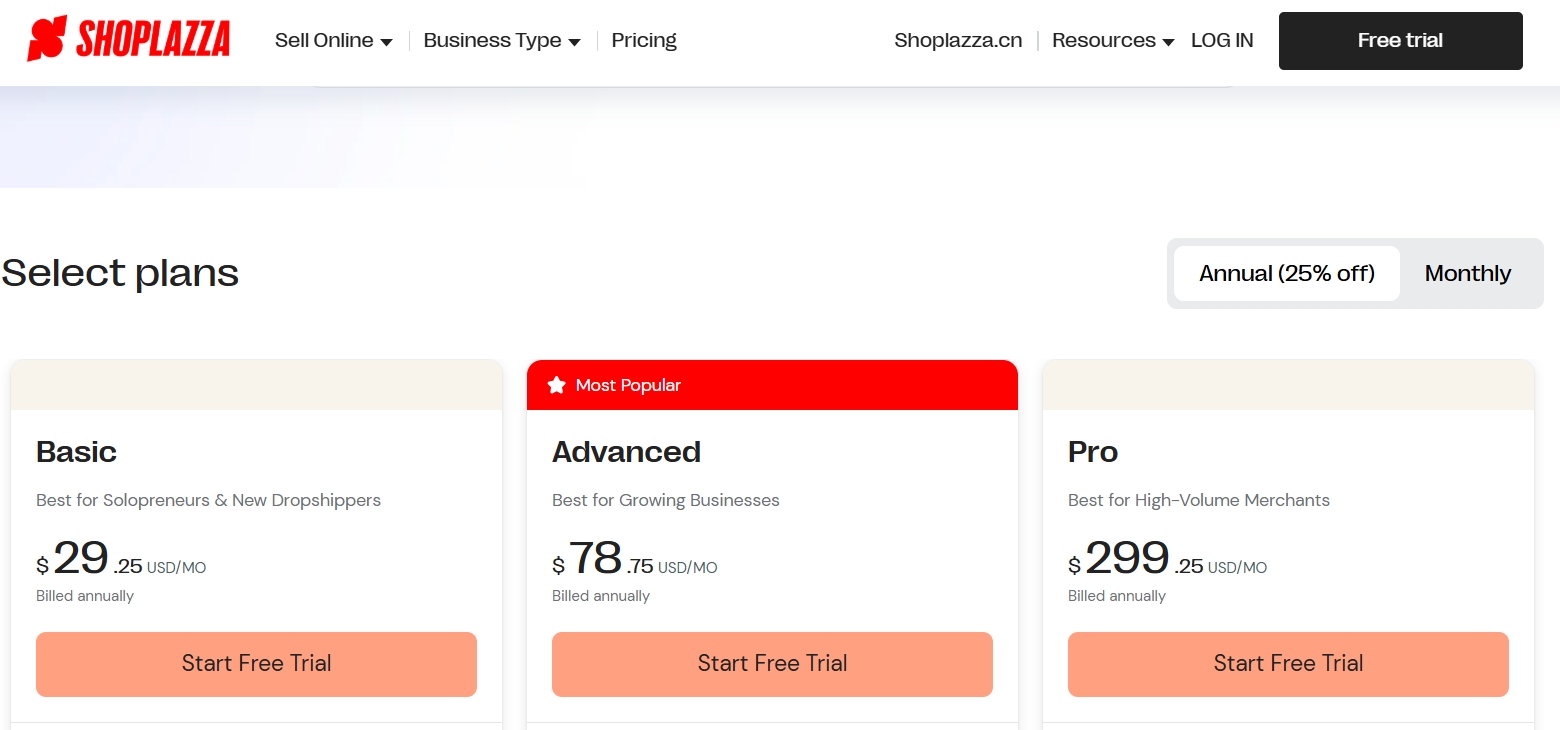
Those subscription prices do not represent your complete operating budget. Evaluating the Total Cost of Ownership (TCO) requires accounting for platform fees, payment processing charges, supplier landed costs, marketing expenses, and refund reserves. Add your domain, payment-processing charges, supplier and shipping costs, samples, returns, advertising, and any paid apps. While many Shoplazza ecosystem apps offer free plans or trial periods, merchants should carefully verify recurring fees and integration charges on the official Shoplazza App Store before installation.
A practical first-month budget should separate fixed costs from per-order costs:
- Fixed: Shoplazza subscription, domain, optional apps, creative tools, and business administration.
- Per order: supplier price, shipping, payment processing, platform transaction fee, packaging, duties, refunds, and customer support.
- Growth: samples, paid traffic, creators, email marketing, and conversion testing.
Decision rule: Do not choose a higher plan only because it sounds more professional. Estimate monthly sales and compare the lower transaction fee with the extra subscription cost. Verify current prices at checkout because plan terms can change.
Is Shoplazza Legit? What Do Real User Reviews Say?
Yes, Shoplazza is a legitimate ecommerce software provider, but “legit platform” does not mean every independent merchant using it is trustworthy. Shoplazza publishes terms and a privacy policy, identifies itself as the technology provider behind merchant stores, and provides integrated payment, fraud-prevention, dispute, and payout tools through Shoplazza Payments where eligible.
Review data requires context. As of 2026, GetApp listed Shoplazza at 4.8 out of 5, but that score came from only six verified reviews. Review volume should be considered alongside rating scores, because a small number of reviews may not represent the experience of all types of merchants using the platform. Software Advice showed the same small sample, with reviewers generally praising functionality and ease of use while noting concerns such as limited customization, price, and occasionally slower support.
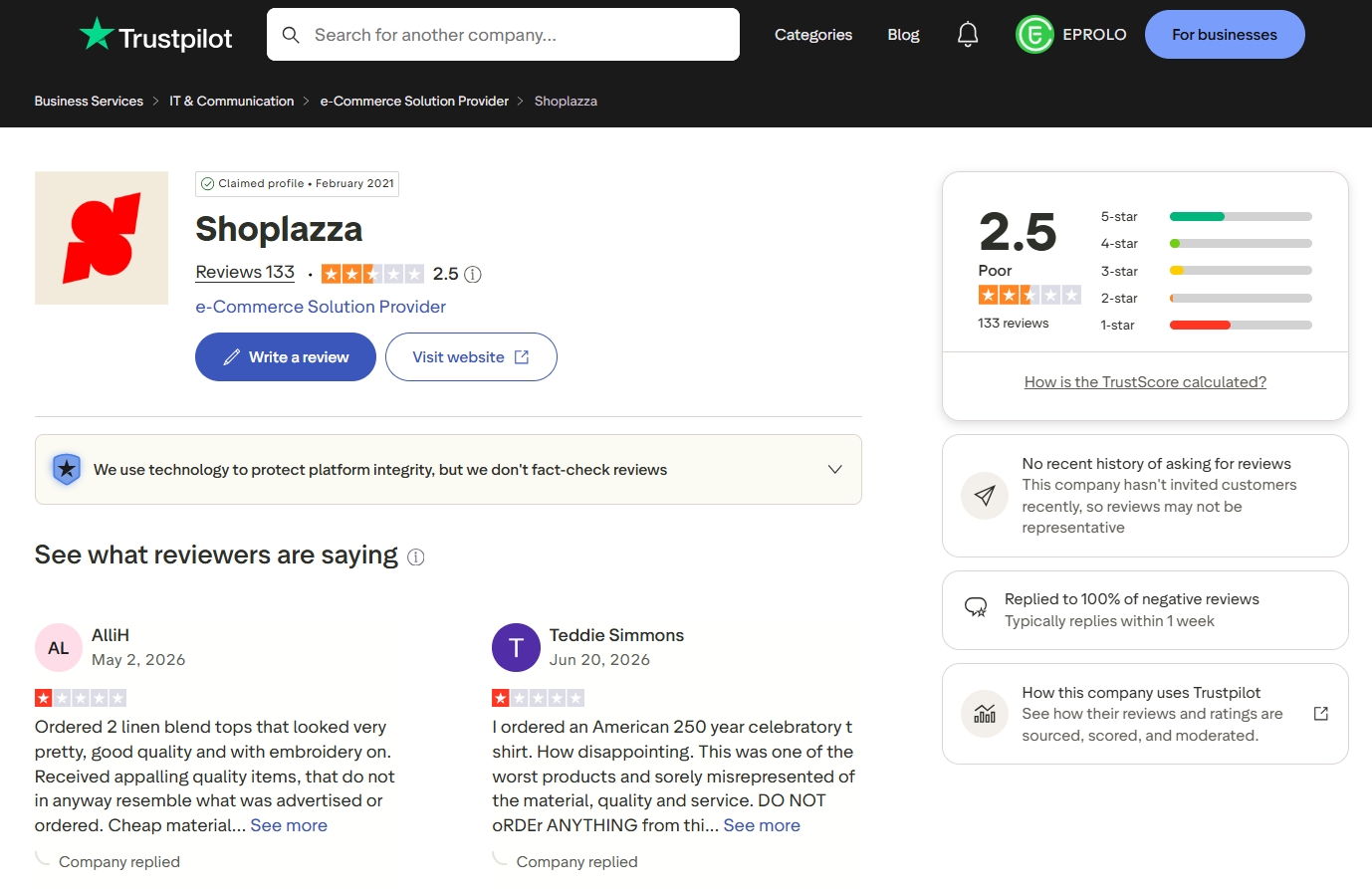
Trustpilot showed a much lower 2.5 out of 5 from 133 reviews. Many of its complaints concerned products purchased from independent stores hosted on Shoplazza, including product quality, returns, missing deliveries, and seller contact. Those complaints matter because they show the risks customers may associate with the platform, but they do not all evaluate Shoplazza's merchant software directly.
Before accepting international payments, confirm these points:
- Your company, owner identity, registered address, and tax documents are eligible for the chosen gateway.
- Your product category complies with Shoplazza, card-network, and payment-provider rules.
- Your refund, shipping, privacy, and contact pages are visible and accurate.
- You understand reserve, dispute, refund, and account-review rules for your payment provider.
- You place a real test order and verify authorization, capture, confirmation email, refund, and reconciliation.
Shoplazza's payment FAQ also notes that payment access can be affected by high dispute rates, poor fulfillment performance, low delivery success, expired documentation, or channel-level risk controls. To ensure uninterrupted cash flow, merchants must keep their chargeback rate strictly below the standard 0.9% threshold through transparent order tracking and compliant handling. Platform security helps, but merchant compliance and supplier execution remain your responsibility.
How to Find Products to Sell on Shoplazza?
Find products by combining demand evidence with a supplier test, not by importing a catalog blindly. Before scaling, experienced sellers evaluate supplier performance across key operational factors, including inventory accuracy, processing lead times, custom branding options, return handling, and tracking synchronization. Shoplazza supports product sourcing mainly through its app ecosystem and one-click dropshipping platform connections. Its Help Center lists tools such as EPROLO, CJdropshipping, DropCommerce, Wholesale2B, and other import or ERP applications.
Use this product-validation sequence before publishing:
- Define one customer problem. A focused store is easier to position than a random general catalog.
- Check demand. Review Google Trends, keyword data, marketplace listings, social discussions, and competitor ads.
- Calculate landed cost. Include product cost, destination-specific shipping, payment fees, platform fees, packaging, refunds, and customer acquisition.
- Check operational risk. Confirm inventory stability, variants, restricted materials, product dimensions, return handling, and shipping coverage.
- Order samples. Inspect product quality, packaging, tracking events, delivery speed, and whether the item matches its listing.
- Run a small test. Publish a narrow assortment and measure conversion, complaints, refund rate, and contribution margin before scaling.
As daily order volume grows, disconnected supplier workflows can create inventory errors, delayed tracking updates, and unnecessary manual work. A dedicated integration like EPROLO helps Shoplazza sellers automate product importing, listing updates, order synchronization, fulfillment, and tracking updates within one workflow. This allows merchants to spend less time managing operations manually and more time improving product selection, marketing, and customer experience. EPROLO also presents its Shoplazza app as free, although product, shipping, customization, and order charges still apply.
How Does Shoplazza Shipping and Fulfillment Work?
Shoplazza controls the checkout rules and order record; the merchant or connected supplier performs fulfillment. In Shoplazza Admin, sellers can create shipping zones and rates by destination, product scope, order price, quantity, or weight. Rates can be fixed, weight-based, or calculated as a percentage of the selling price.
A connected dropshipping workflow usually follows these steps:
- The customer pays through the Shoplazza storefront.
- Shoplazza creates the sales order and records the address, items, payment, and selected shipping option.
- The connected supplier app synchronizes or receives the order.
- The merchant reviews and pays the supplier where required.
- The supplier sources or picks the product, performs quality checks, packs it, and ships it.
- The tracking number syncs back to the store so the merchant and customer can follow the shipment.
With EPROLO's Shoplazza integration, the order is described as synchronizing automatically to EPROLO. After the merchant pays, EPROLO handles purchasing, inspection, packaging, and delivery, then uploads the tracking number to the store. That automation reduces copy-and-paste work, but it does not remove the need to verify stock, address exceptions, shipping lines, customs exposure, and return procedures.
Build shipping promises from evidence
- Test each major destination with a sample shipment.
- Separate processing time from carrier transit time.
- Add a buffer for sourcing, weekends, customs, and remote areas.
- Do not advertise one global delivery time when routes differ by country and product.
- Keep tracking, delay, lost-package, and refund instructions visible.
- Avoid mixing suppliers in one order unless you disclose split shipments clearly.
Shoplazza shipping settings determine what the customer sees and pays at checkout. They do not guarantee that a supplier can meet that promise. Reconcile your store's rate table with live supplier quotes before launch, making sure to account for volumetric weight rather than gross weight alone. Re-verify fulfillment fees whenever product packaging, destination zones, or carrier conditions change. Cross-border merchants targeting Europe must also account for regulatory changes; from July 1, 2026, the EU applies a temporary €3 customs duty per item on low-value consignments up to €150 imported from outside the EU, replacing the previous duty exemption. Including this additional duty impact alongside existing VAT obligations in landed-cost calculations is essential for maintaining accurate pricing. For a practical checklist on adapting your fulfillment strategy, merchants can refer to EPROLO’s EU customs duty merchant playbook.
What AI Features Does Shoplazza Offer for Dropshipping?
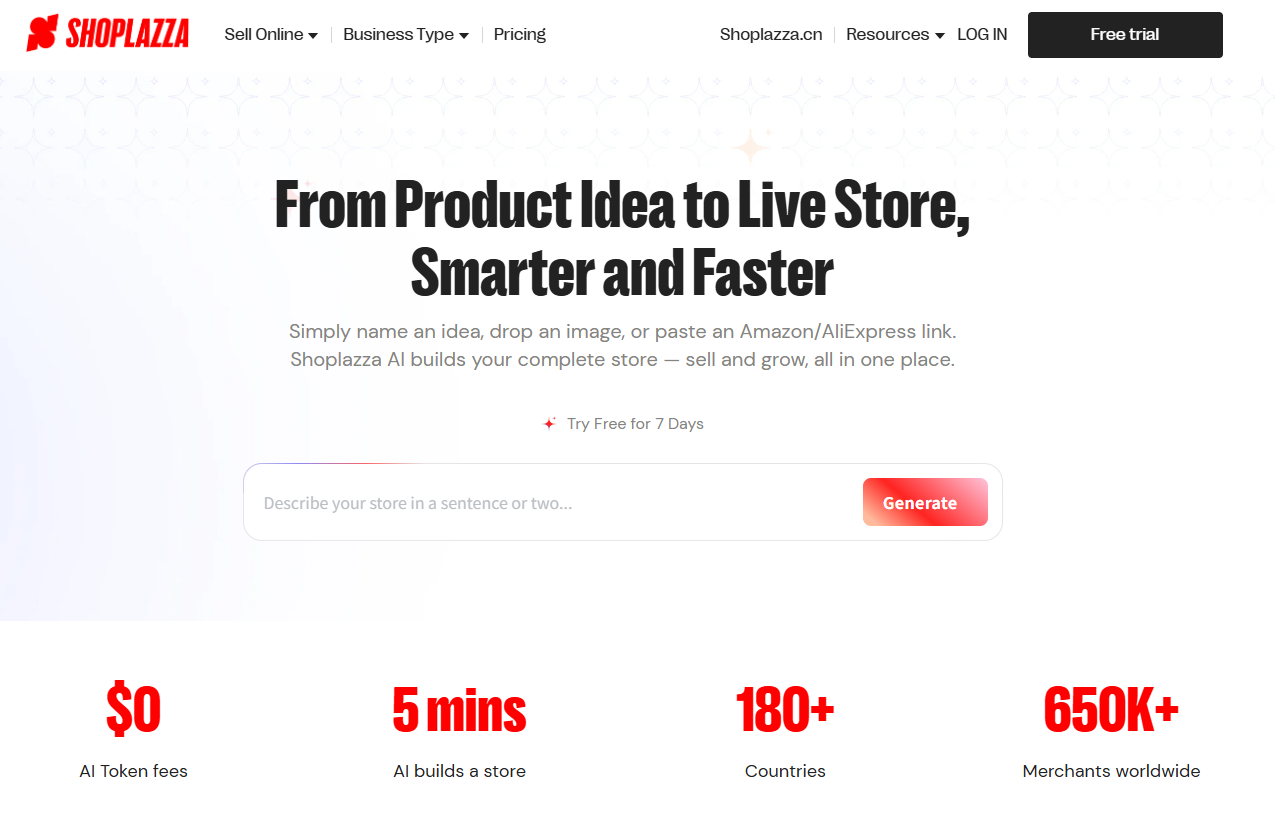
Shoplazza now offers AI for store generation and back-office execution, but merchants should review every output before publishing or confirming changes. Its AI Store Builder can generate a store framework from a text prompt and lets the seller edit layouts, copy, colors, and images through a drag-and-drop interface.
Shoplazza's broader AI materials describe capabilities that include:
- AI-generated store pages and editable storefront design.
- Product-content and visual creation.
- SEO-oriented content assistance.
- Advertising, email, and analytics support.
- Natural-language product creation and bulk editing.
- Order filtering, promotion setup, and shipping configuration.
- Sales analysis, charts, summaries, and operational recommendations.
Athena, Shoplazza's in-admin AI assistant, is designed to preview an operation and request confirmation before creating, changing, or deleting data. This human-in-the-loop checkpoint is critical to prevent automated errors in price formatting, SKU mapping, or stock synchronization across connected ERPs. AI-generated titles, descriptions, prices, and shipping settings can still contain errors or generic claims.
Use AI to draft and accelerate work, then manually verify product facts, dimensions, materials, compliance language, margins, stock, shipping charges, and brand voice. AI can reduce administrative time; it cannot repair an unreliable supplier or an unprofitable offer.
Shoplazza vs Shopify: Which Platform Should I Choose?
Choose Shoplazza when you prefer a more self-contained cross-border setup and direct supplier options; choose Shopify when ecosystem breadth and mature third-party support matter more. Beyond subscription fees, merchants should evaluate app ecosystem requirements, supplier accessibility, operational workload, and long-term scalability. A platform that looks cheaper initially may require more third-party tools, manual management, or integration work as the store grows. Both platforms can run a dropshipping store, and both require a separate supplier or fulfillment connection.
| Decision factor | Shoplazza | Shopify |
|---|---|---|
| Entry price shown in July 2026 | $39 monthly or $29.25/month billed annually | $39 monthly or $29/month billed annually for Basic |
| AI | AI store generation plus Athena for product, promotion, shipping, order, and data tasks | AI-assisted store creation and Sidekick for content, insights, and commerce tasks |
| International selling | Promotes up to 50 markets and 180+ payment methods | Strong global selling tools, with advanced regional capabilities on higher tiers |
| Apps and partners | Smaller ecosystem, with direct dropshipping options including EPROLO and CJdropshipping | Much larger app, theme, agency, developer, and integration ecosystem |
| Best fit | Cross-border sellers who value built-in functions and a simpler supplier path | Sellers who want maximum ecosystem choice, documentation, and customization depth |
Do not compare subscription prices alone. Build a 12-month total-cost model that includes paid apps, payment fees, transaction fees, theme or development work, migration effort, and staff time. Then create a trial store on each platform and test the same product, checkout, tax, shipping, supplier sync, tracking, refund, and reporting workflow.
Shopify's scale creates more choices and support resources, but those choices can add app costs and operational complexity. Shoplazza can feel more consolidated for cross-border dropshipping, yet its smaller ecosystem may matter when you need a specialized integration or developer. The right answer depends on the workflow you can verify, not a universal platform ranking.
Start Your Shoplazza Dropshipping Store Today
If Shoplazza fits your budget and market, launch in controlled stages:
- Start the trial and build one niche-focused storefront.
- Connect a supplier app and import a limited product set.
- Rewrite every supplier title and description for accuracy and differentiation.
- Configure payments, taxes, shipping zones, and customer policies.
- Place sample orders to your priority countries.
- Test cancellation, refund, tracking, and support workflows.
- Launch with a small traffic budget and track contribution margin, not revenue alone.
EPROLO offers a direct Shoplazza integration for product importing, order synchronization, fulfillment, and tracking updates. Use the connection as an operational starting point, then validate every important SKU and destination before increasing ad spend.
Frequently Asked Questions (FAQs)
Is shoplazza free during the initial setup phase?
Shoplazza lets you preview an AI-generated store and offers a seven-day free trial for the full platform. A paid plan is required to continue operating the store after the trial. Current monthly plans begin at $39, while annual billing lowers the displayed monthly equivalent.
Is shoplazza legit for handling international customer payments?
Shoplazza is a legitimate ecommerce platform. However, payment availability depends on your business location, documents, products, chosen gateway, dispute rate, fulfillment performance, and compliance. Verify gateway eligibility and complete a live payment and refund test before launch.
How do suppliers connect to Shoplazza for automated shipping?
Suppliers usually connect through a Shoplazza App Store integration or an ERP/API connection. With EPROLO, the seller installs and authorizes the app, imports products, and connects the store. Customer orders then synchronize to EPROLO for payment and fulfillment, and tracking can sync back after shipment.
What tools help automate order fulfillment and inventory sync on Shoplazza?
Options include EPROLO, CJdropshipping, Wholesale2B, Mabang ERP, and other sourcing or ERP apps listed by Shoplazza. Capabilities vary, so confirm product import, stock updates, order routing, tracking sync, refunds, destination coverage, and pricing before choosing a tool.
Can beginners start dropshipping with zero inventory cost?
Yes. Dropshipping lets beginners list products without buying inventory in advance, and the supplier is paid when an order needs fulfillment. The business is not cost-free: expect platform, domain, sample, payment, shipping, return, and marketing expenses.
How fast do Shoplazza orders sync with global fulfillment partners?
Connected apps can synchronize orders automatically, but no single speed applies to every partner or exception. Confirm the app's current sync behavior and test a live order. Order synchronization is also separate from sourcing, processing, carrier pickup, customs, and final delivery time.
Related Reading
Written by
Inverse is a skilled Google SEO operations expert, with deep expertise in technical site audits, content clustering, and keyword strategy. Excelling at search engine visibility and organic traffic optimization, Inverse consistently delivers actionable insights across key search channels. This strategic approach helps e-commerce brands build sustainable organic traffic and expand their digital footprint effectively.
Editorial note: Pricing, features, app terms, and review scores were checked against official Shoplazza and EPROLO pages plus third-party review platforms in July 2026. Vendor claims are identified where relevant. Platform terms can change, so verify current pricing, eligibility, fees, and integration behavior before purchasing or publishing delivery promises.