Picking the next round of styles for your store used to mean scrolling Instagram until something felt right. In 2026, that approach burns through both ad spend and warehouse space. Fashion dropshipping has matured into a numbers-first game, and the sellers who scale are the ones who combine real demand data, a private label branding strategy, and a tight feedback loop with their actual buyers.
This guide walks through a repeatable framework for clothing sourcing: when to chase a trend, when to anchor on evergreen pieces, where to find reliable demand data (and which "trending" panels to ignore), how EPROLO's custom branding service lets you stand out without holding inventory, what fabric and fit data to demand from suppliers, and how to turn customer reviews into your next collection brief. No magic. Just a system.
What to know first
- Trend half-life in fast fashion inventory has dropped from roughly 6 weeks to under 3 weeks. Speed beats perfection.
- Evergreen pieces still drive 60–70% of repeat purchase volume for most apparel stores. Don't starve them.
- "Trending products" panels inside supplier dashboards are often recycled marketing lists, not real-time demand. Treat them as one input, not the source of truth.
- Custom branding (private label, custom labels, poly mailers, insert cards) is the only durable moat a dropshipped fashion store can build. Use it.
Short version
Anchor 60% of the catalog on evergreen pieces, reserve 30% for validated trends you can source and ship in under 14 days, and use the final 10% as controlled experiments. Source through a supplier like EPROLO, layer custom branding on every order, and let customer review data decide which SKUs make it to the next season.
Inside this article
- When to Follow Trends vs. When to Stick to Evergreen Styles
- How to Read Real Demand Signals for High-Demand Apparel
- Building a Branded Fashion Line: Private Label, Labels, and Packaging
- Analyzing Fabric, Fit, and Function for Your Actual Customer
- Why Customer Reviews Are Your Best Sourcing Compass
- Start Scaling Your Branded Fashion Brand Today
- FAQ
When to Follow Trends vs. When to Stick to Evergreen Styles
The fastest way to lose money in fashion dropshipping is treating every product as a trend bet. The second fastest is treating every product as evergreen. The healthy catalog mixes both, with explicit budget and shelf space for each.
A practical split for a starter-to-mid store looks like this:
| Category | Share of catalog | Buy cycle | Decision signal |
|---|---|---|---|
| Evergreen basics (tees, leggings, plain tanks) | 50–60% | Reorder every 30–45 days | Stable 4.3+ review average, low return rate under 8% |
| Validated micro-trends (3–6 weeks) | 25–30% | Test batch, then full SKU | Amazon Best Sellers rank + Google Trends 4-week uptrend |
| Experimental capsules | 10–15% | Single small run, kill fast | Ad CTR, add-to-cart, repeat-buyer conversion |
The split is not a moral rule. It is a budgeting tool. If your advertising cost per purchase is climbing and your repeat buyer rate is flat, the catalog is probably overweight on micro-trends and underweight on basics that come back. If your return rate is above 12% and reviews keep mentioning "size up", the basics block is being sourced from a supplier whose size chart does not match your store's chart.
How to Read Real Demand Signals for High-Demand Apparel
A common mistake is treating the "trending products" carousel inside a supplier's homepage as a research tool. Most of those lists are marketing assets, refreshed monthly, with no sales volume attached. The signals that actually move the needle for fashion dropshipping are public, free, and verifiable. Use them in this order.
1. Amazon Best Sellers, Movers & Shakers, and New Releases
Amazon's Best Sellers rank is hourly updated and is the closest thing to a real-time demand thermometer in apparel. Open the Amazon Best Sellers page, navigate to the Clothing, Shoes & Jewelry department, and drill into a sub-category (women's linen sets, men's oversized tees, unisex activewear). Look for products that hold a top-100 rank for at least two consecutive weeks. The "Movers & Shakers" tab is faster but noisier; use it for ideas, not for SKU decisions. Note: Amazon blocks scripted access, so verify trends in a real browser session, not via API.
2. Google Trends for category momentum
Google Trends is free and shows search interest over time, normalized to 100. Compare three to four candidate categories (linen sets, wide-leg cargos, drop-shoulder tees, tennis-core) over a 90-day window. A category that has been climbing for 4–6 weeks but has not yet peaked is your entry window. A category that already peaked is a margin trap.
3. AliExpress Dropshipping Center for supplier-side validation
AliExpress's Dropshipping Center shows search growth, sales volume on the platform, and supplier ratings. Use it to confirm that a trend you spotted on Amazon and Google Trends also has supplier depth (multiple sellers, real orders, consistent reviews). If a category only has 2–3 suppliers on AliExpress, your backup plan is thin and you should pass.
4. TikTok Creative Center for early signal
TikTok Creative Center surfaces trending hashtags and ad creatives by region. For fashion, look for hashtags like #linendress, #widepants, or #oversizedtshirt in your target country. The signal is noisy but it leads Amazon by 2–4 weeks on aesthetic-driven trends. Treat it as a discovery layer, then validate with the three sources above before placing a test order.
5. Cross-reference with EPROLO's blog best-products list
EPROLO maintains a 150+ Best Dropshipping Products for 2026 article that updates quarterly and groups candidates by niche. It is not a real-time demand source, but it is a useful sanity check: if a candidate SKU does not appear in any of Amazon, Google Trends, AliExpress, or the EPROLO best-products roundup, it is probably not worth a test order.
6. Run a 14-day pilot before scaling ad spend
Run a 14-day pilot before scaling ad spend. List the candidate SKU at a moderate price, run a fixed ad budget, and watch three numbers: add-to-cart rate, checkout completion, and review sentiment. If add-to-cart clears 8% and reviews stay above 4.2 stars in the first two weeks, scale. If not, kill the SKU and re-allocate the budget to the next candidate.
Building a Branded Fashion Line: Private Label, Labels, and Packaging
Two stores can sell the same supplier's plain black tee and live in completely different worlds. The store that wraps the tee in a custom-branded unboxing earns repeat buyers; the store that ships in a clear poly mailer earns one-time orders. For fashion dropshipping, custom branding is not a nice-to-have. It is the only durable moat a no-inventory operator can build.
EPROLO's custom branding service is built around this exact problem. It is free to enroll, no minimum order quantity, and covers the four touchpoints a customer actually notices.
Custom neck labels and inner tags
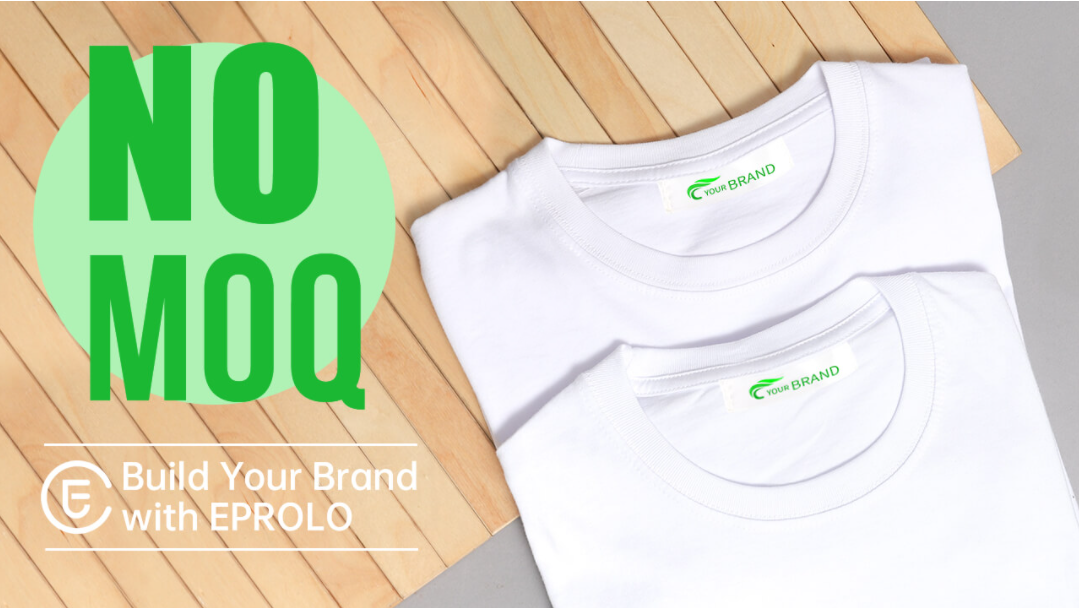
The first branded surface your customer sees is the inside of the garment. EPROLO replaces the supplier's stock neck label with your logo at no extra per-unit cost above the standard sourcing fee. The minimum setup is a logo file; a woven label upgrade is available for higher-tier SKUs. Treat the neck label as your permanent signature: every garment in your store should carry it, including the basics block.
Custom packaging: poly mailers, boxes, and tissue
The outside of the package is the unboxing photo. A custom poly mailer with your logo and a flat-color background (EPROLO uses its own green family; pick one that fits your store's palette) is enough to make a TikTok unboxing shareable. For premium SKUs above a $30 average selling price, upgrade to a custom box with tissue and a sticker seal. The unit cost is real but the brand lift is permanent.
Insert cards and thank-you notes
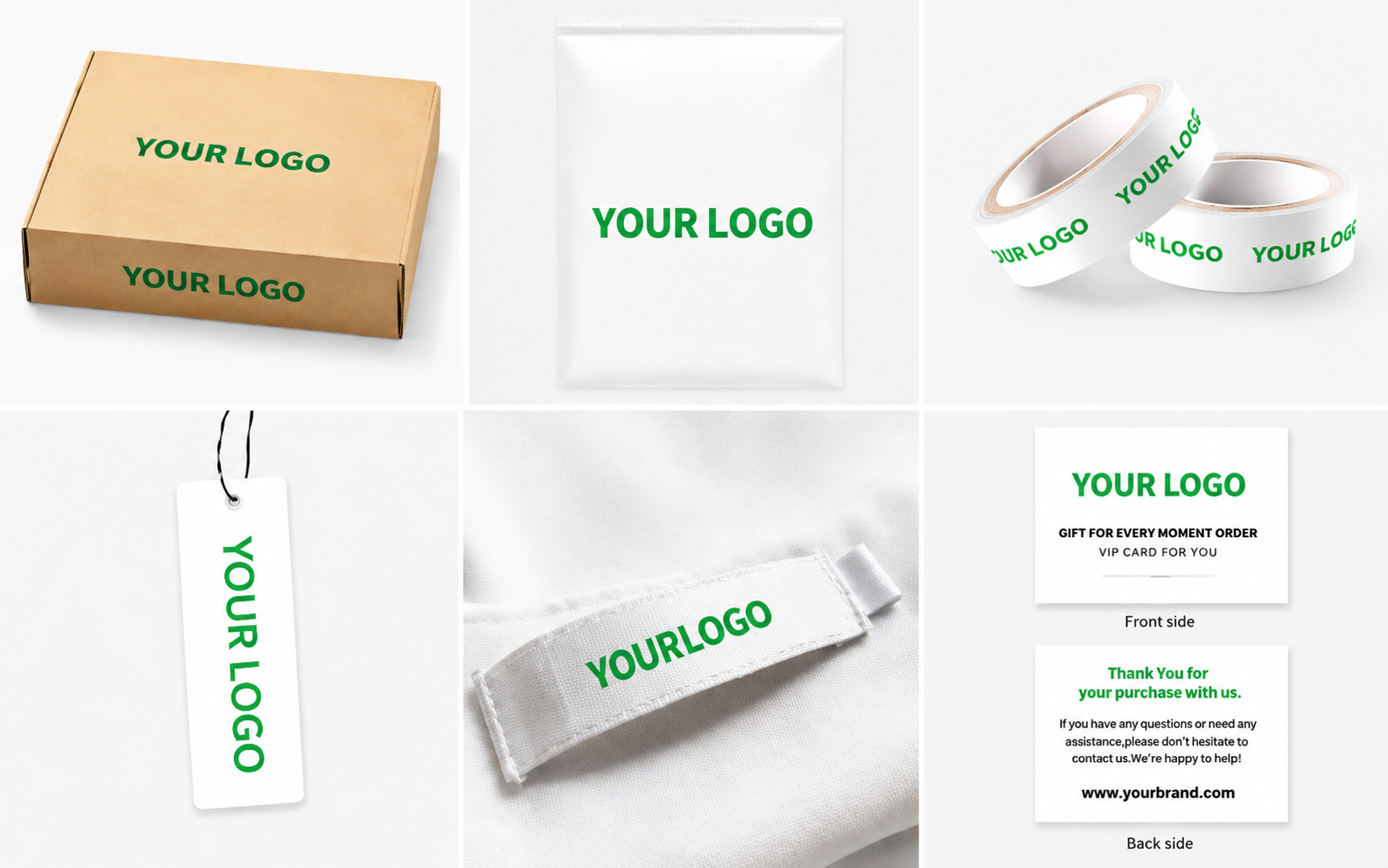
A small printed card (4×6 inches, 300gsm matte) with a short handwritten-style note, a discount code for the next order, and a QR code linking to your Instagram or TikTok is the cheapest repeat-purchase tool in fashion. The QR code is the important part: it turns a one-time buyer into a tracked follow target for retargeting ads. EPROLO's insert card option ships with the order and does not require you to hold inventory.
Stickers, hang tags, and care labels
Stickers on the outside of the poly mailer and a branded hang tag on the garment are the lower-cost siblings of custom packaging. They work well for capsule drops and limited editions where you want the packaging itself to feel collectible. Custom care labels (fabric composition, washing instructions, country of origin) are a smaller upgrade but they signal "this is a real brand" in a way stock labels do not.
Print-on-demand for graphic apparel
If your fashion line includes graphic tees, hoodies, or tote bags, EPROLO's print-on-demand service lets you upload a design and have it printed, packed, and shipped under your brand. The unit economics are tighter than blank-apparel sourcing, so use POD for hero designs and small-batch drops, not for the evergreen basics block.
How to roll out custom branding in 30 days
Week 1: design a logo, lock a color palette, and order neck-label samples from EPROLO. Week 2: design poly mailer, insert card, and sticker. Week 3: enable branding on your top 20 SKUs (the evergreen block) and route every new order through the branded workflow. Week 4: measure branded-order repeat purchase rate and review sentiment against your unbranded baseline. A typical branded fashion store sees repeat purchase rate climb 15–25% within the first quarter, though results vary by niche and product quality.
Analyzing Fabric, Fit, and Function for Your Actual Customer
A trend product and a quality product are not the same thing. Fashion dropshipping operators who scale past their first $50K a month are almost always the ones who read the fabric spec sheet, not just the product photo. Here is the order of checks that should happen before any SKU is added to your store.
1. Fabric composition and weight
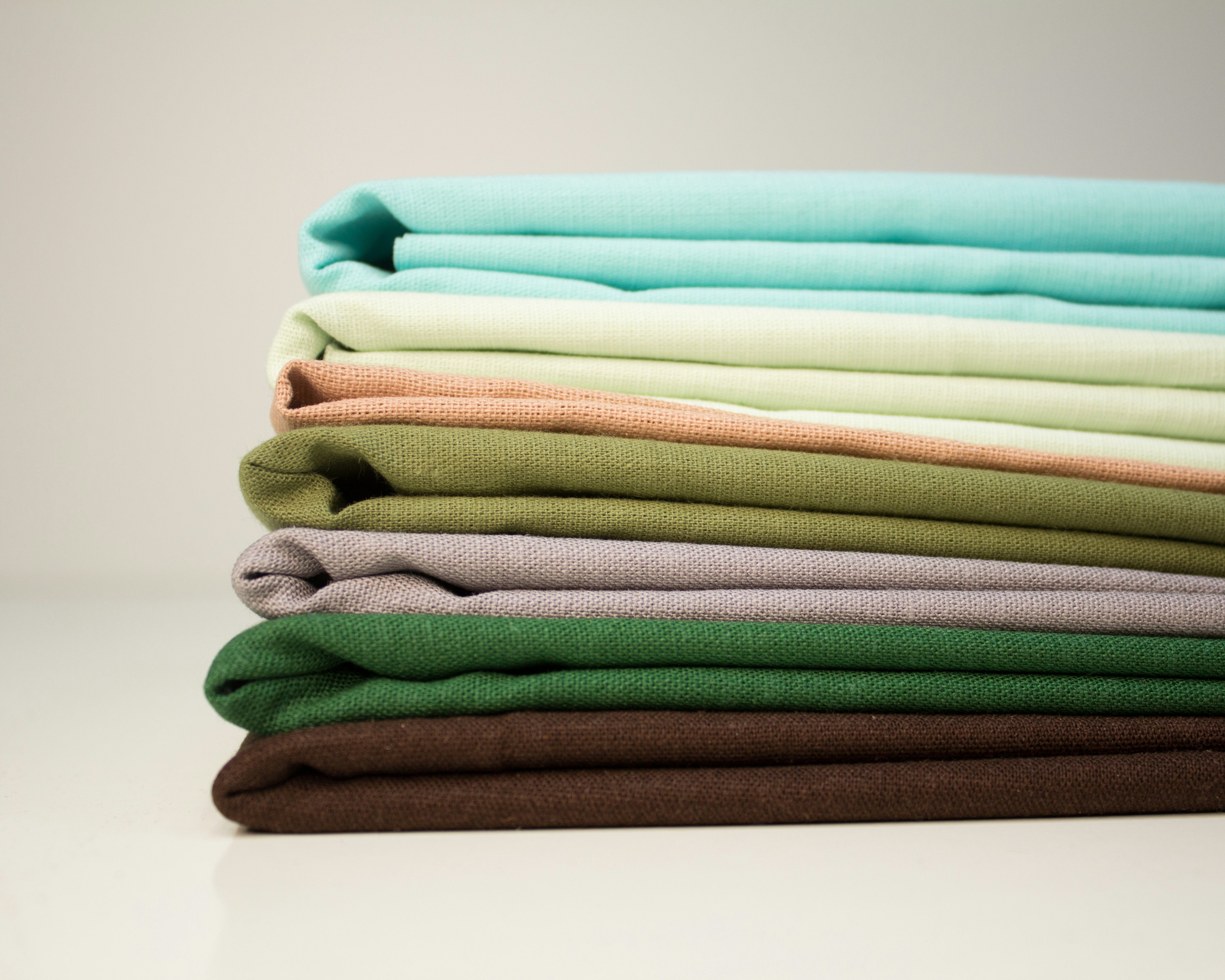
Ask the supplier for the GSM (grams per square meter) on knits and the exact fiber blend. A 180 GSM cotton tee and a 220 GSM cotton tee look similar in photos, but the heavier one shrinks less, holds shape better, and earns stronger reviews. For bottoms, the blend ratio matters more than the headline fabric: a 95% polyester, 5% spandex trouser behaves very differently from a 70% polyester, 25% rayon, 5% spandex trouser in the wash.
2. Size chart and tolerance
Request a size chart in centimeters with a tolerance window, not just S/M/L labels. A 2 cm chest tolerance on a top is acceptable. A 5 cm chest tolerance means the same labeled size will fit three different body types, and your return rate will climb. Compare the supplier's chart against at least one of your existing best-selling products to confirm the block is consistent.
3. Functional details your customer actually uses
Pocket depth, drawstring length, button material, zipper gauge, and lining presence are details that show up in 1-star reviews. Before adding a piece, read the supplier's existing reviews on EPROLO and on the product page itself. Cluster the negative comments. If three or more reviewers mention the same functional issue, that is a sourcing red flag, not a customer problem.
4. Order a sample for anything above $20 ASP
For higher average selling price items, a $10–15 sample is the cheapest insurance you can buy. Photograph it on a real person, not a mannequin, and use those photos in your first ad creative. Customers forgive off-model photos from a small store far more than they forgive mismatched photos.
Why Customer Reviews Are Your Best Sourcing Compass
Most fashion dropshipping stores treat reviews as a marketing asset. The better move is to treat them as a sourcing tool. Every 4-star and below review is a free consultant telling you which supplier, which size block, and which fabric is not pulling its weight. Once you layer custom branding on top, reviews also become a brand signal: customers will reference the unboxing, the labels, and the packaging in their 5-star write-ups, and that language is reusable copy for your product page.
Build a weekly review audit
Set aside 30 minutes every Monday. Pull all new reviews for the past 7 days, sort them by star rating, and tag each one with three labels: product, supplier, issue. After 4 weeks you will have a heatmap of which products are earning repeat buyers and which are quietly bleeding margin through returns.
Look for pattern words, not isolated complaints
One customer saying "runs small" is noise. Three customers saying "runs small" within a week is a pattern. Common high-signal words to track: "shrunk", "thin", "see-through", "color different", "zipper broke", "loose stitching", "size up", "size down". Each of these points to a specific fix you can ask your supplier for, or a different supplier entirely.
Feed review insights back into your next sourcing brief
When you brief a new product for the next season, lead with the review findings, not the trend report. "We need a wide-leg trouser in 220 GSM cotton-blend, lined waistband, drawstring with metal tips, and a side pocket depth of at least 14 cm" will outperform "we need a wide-leg trouser" every time. The supplier matching against the first brief will ship a better product, and the customer will feel the difference.
Use 5-star reviews to write your next product page
The language your buyers use is the language your next buyers search for. Pull phrases from 5-star reviews and lift them into titles, bullet points, and meta descriptions. A bullet that reads "soft, not see-through" outperforms "premium cotton blend" because it answers a real question a real shopper is typing.
Start Scaling Your Branded Fashion Brand Today
A winning fashion collection in 2026 is not built on taste. It is built on a four-step loop: validate the trend with real demand data, source through a supplier that supports custom branding, audit fabric and fit against your actual customer, then promote or kill the SKU based on real review data. Repeat weekly. Over 90 days the winners compound, the losers get cut, and your catalog starts to look like something a customer would actually bookmark.
If you are starting from zero, the lowest-risk first move is to pick one evergreen category and one trending sub-category, source both through EPROLO, enable custom branding on day one, and run them in parallel for 30 days. The evergreen teaches you your baseline return rate and customer. The trend teaches you where the next opportunity is. After 30 days you will have a real budget, a real sourcing brief, and a real point of view about what your store should be.
Editorial note
- Data Notice: The 60/30/10 catalog split and 15–25% repeat-purchase lift are industry benchmarks and estimates, not financial guarantees. Test against your own data before scaling.
- Flexibility: Adjust your inventory ratios dynamically. Stronger brands may lean up to 70% evergreen, while new stores may temporarily run up to 40% micro-trends.
- References: Data compiled from EPROLO documentation, 2026 Shopify/Apparel industry trends, Google Trends, Amazon Best Sellers, and TikTok Creative Center.
FAQ
What are the best-selling fashion niches for dropshipping?
The most consistent performers in 2026 are women's linen and cotton-blend sets, wide-leg trousers, drop-shoulder tees, men's oversized basics, and unisex knitwear. Best-selling is a moving target by month, so pair your niche list with Amazon Best Sellers and Google Trends and refresh it every two weeks rather than relying on a fixed list from a single article.
How to ensure product quality when dropshipping clothing?
Combine three checks: order a physical sample for any SKU above $20 average selling price, read at least 20 recent supplier reviews on the platform before adding the product, and run a 14-day small-batch pilot so you can spot quality issues before scaling ad spend. Quality is a percentage game; you are trying to keep the defect rate below your margin floor, not eliminate it.
How to handle seasonal fashion stock changes?
Plan a 6-week runway before each major seasonal shift. For spring 2026 that means locking suppliers and finalizing size charts by late January, running a test batch in early February, and going to full campaign spend by late February. For fast fashion inventory, the rule is shorter: begin pulling trend candidates 4 weeks before the projected trend peak, not 4 weeks before the season itself.
How to find trending products before they become saturated?
Watch the 4–6 week growth window on Google Trends, cross-check with Amazon Best Sellers to confirm durability, scan TikTok Creative Center for early aesthetic signals, and look for products that are gaining in your niche but have not yet hit the top 100 of major marketplaces. Once a product reaches the front page of Amazon or the top 10 of TikTok Shop, the margin window is already closing.
How do I test if a product will sell without bulk buying?
Use a 14-day small-batch pilot. List the SKU at a moderate price, run a controlled ad budget, and measure add-to-cart rate, checkout completion, and early review sentiment. With dropshipping, your "small batch" is your test order from the supplier; you are not buying inventory upfront, but you should still cap ad spend at a fixed dollar amount so a bad product cannot drain the month's budget.
How to turn customer suggestions into new products?
Cluster your 4 and 5-star review text by request phrases such as "wish this came in", "would buy in", and "if you had a". Run the cluster monthly. The phrases that appear most often become the input for your next sourcing brief: a specific fabric, a specific color, a specific silhouette your existing buyers are actively asking for. That is your lowest-risk new SKU.
How do I add custom branding to my dropshipping orders?
Enroll in EPROLO's custom branding service, upload your logo and color palette, and choose the touchpoints you want branded: neck labels, poly mailers, insert cards, stickers, hang tags, or care labels. There is no minimum order quantity for branded neck labels and packaging on EPROLO, so you can roll branding out across your evergreen block on day one. The cost is added to the per-unit sourcing fee and shows up in your order dashboard before fulfillment.
Is custom branding worth it for a brand-new store?
Yes, and earlier is better. A new store with a branded unboxing earns higher first impression scores, better review sentiment on packaging, and a higher chance of a second order than the same store shipping in a plain poly mailer. The unit-cost increase is small relative to the repeat-purchase lift, and it compounds: a customer who recognizes your packaging in a TikTok unboxing is far more likely to buy again. EPROLO's free enrollment and no-MOQ labels make it practical from order one.
Read More from EPROLO Blog
Written by Josie
Josie is a skilled marketing specialist with expertise in TikTok, Facebook, and YouTube. She excels at audience growth and social media account management, consistently delivering valuable insights across key social marketing channels. Her strategic approach helps brands build meaningful engagement and expand their digital presence effectively.