Learning how to control quality in dropshipping means replacing hands-on inventory control with a measurable system. You need approved samples, written specifications, supplier defect limits, periodic test orders, pre-shipment checks, and a fast damaged-order response. Without direct inventory ownership, dropshipping merchants face higher risks of product inconsistency, supplier changes, and customer dissatisfaction because quality issues are often discovered only after delivery. This guide gives independent store owners a practical operating procedure they can use before launch and while scaling paid traffic.
Key Takeaways
- Turn the approved sample into a written control standard with photos and tolerances.
- Audit live orders repeatedly because one good sample does not prove future batches.
- Use a defect SLA that defines severity, evidence, remedies, and response time.
- Inspect packaging and shipping labels as carefully as the product itself.
- Resolve damaged arrivals quickly and preserve evidence before a dispute escalates.
Table of Contents
- What is dropshipping quality control?
- Why quality control matters for dropshipping stores
- How to test product samples before selling
- How to prevent supplier quality drop when scaling
- How sourcing agents handle quality checks before shipping
- What to do when a customer receives a broken product
- Dropshipping product quality control checklist
- Common quality control mistakes to avoid
- FAQs about dropshipping quality control
What is dropshipping quality control?
Dropshipping quality control is the system used to verify that the product, variant, packaging, label, and parcel sent by a supplier match the store's approved standard. The merchant may never touch normal customer inventory, but the merchant can still define measurable requirements and collect evidence at specific checkpoints.
The challenge of managing quality without physical inventory
The customer buys from your storefront, the factory produces the item, and a supplier or fulfillment partner dispatches it. Each party sees a different part of the transaction. The factory may know a material changed, the supplier may know a substitute workshop was used, and the customer may be the first person connected to your brand who opens the parcel.
This information gap is why verbal promises are weak. Effective dropshipping supplier quality management creates a shared record: approved sample ID, specifications, acceptable defects, packaging instructions, inspection photos, batch date, tracking number, and customer outcome.
Quality control vs. Quality assurance in e-commerce
| Discipline | What it checks | Dropshipping example |
|---|---|---|
| Quality control (QC) | Physical units and parcels | Measure a sample, test its function, inspect a live parcel, and photograph defects. |
| Quality assurance (QA) | The supplier's process and controls | Vet production capability, approve materials, define an SLA, and control substitutions. |
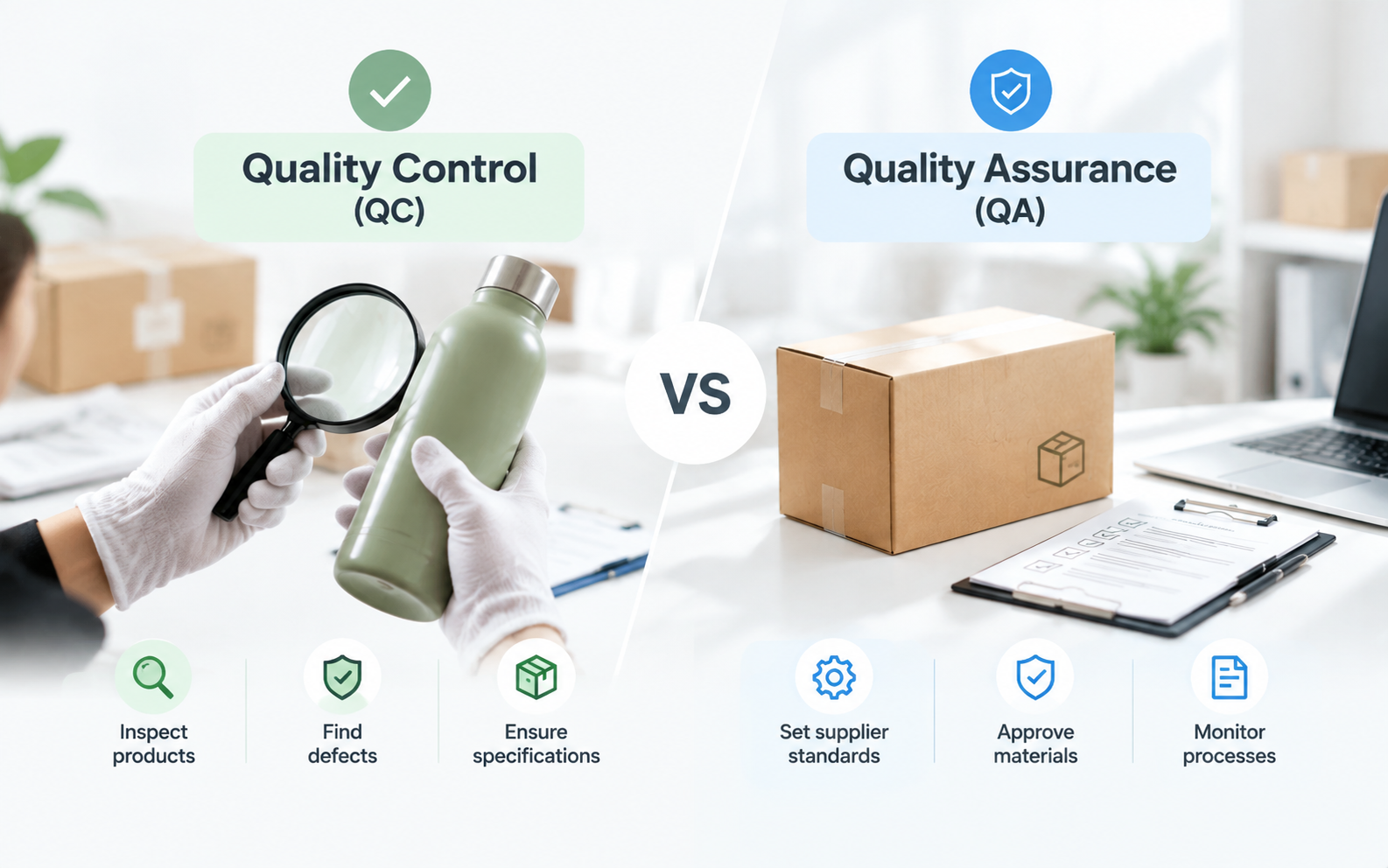
QC finds a bad item. QA reduces the chance that bad items are produced or shipped. A complete quality control in e-commerce program needs both. Sample tests without supplier controls become stale, while a polished supplier presentation without physical checks provides no proof of current output. For merchants working with larger suppliers or higher-volume products, established quality management approaches such as AQL sampling methods and ISO 9001 principles can provide useful references when defining inspection expectations.
Why quality control matters for dropshipping stores
A defective product rarely creates only one cost. It can trigger a refund, replacement, support time, lost ad spend, a negative review, and a payment dispute. For dropshipping businesses, the impact is often higher because merchants typically discover quality problems after the product has already reached the customer. This makes prevention, documentation, and supplier accountability critical parts of scalable operations.

Customer experience signals are increasingly important across ecommerce platforms and payment providers. Poor product quality can contribute to negative reviews, refund requests, disputes, and account performance issues. Therefore, sellers should treat quality control as part of customer experience management rather than only a supplier inspection task.
| Quality failure | Immediate cost | Account-level risk |
|---|---|---|
| Wrong variant or missing component | Replacement, refund, support | Complaints and negative feedback |
| Fragile item arrives broken | Product loss plus reshipping | Disputes, reserves, review damage |
| Product differs from the ad | Refunded acquisition cost | Ad delivery restrictions or suspension |
How to test product samples before selling
Do not inspect a sample by asking whether it “looks good.” A professional sample review should compare the product against documented specifications, customer expectations, and future production requirements. Use the same rubric for every candidate and save the results. EPROLO's help center documents a sample-order process after registration, so a merchant can order the product to a real address before listing it.

- Order at least two units when practical. One unit tests the item; the second reveals whether color, measurements, finish, and included parts are consistent.
- Use the customer's shipping route. Send the sample through the same method and destination market you plan to advertise.
- Record the unboxing. Photograph the label, outer parcel, protective material, product box, accessories, and first visible condition.
- Compare the listing. Verify material, color, dimensions, weight, quantity, logo, instructions, plug type, and every advertised function.
- Stress the product realistically. Repeat normal use, inspect seams and joints, check charging or moving parts, and test closures, fasteners, or liquids where relevant.
- Score the experience. Fail the sample if a critical function or safety requirement fails, even when the average score looks acceptable.
- Create the golden-sample file. Save approved photos, measurements, packaging order, and the supplier SKU as the baseline for later batches.
| Test area | Weight | Pass standard | Automatic fail |
|---|---|---|---|
| Listing accuracy | 20% | Variant and specifications match | Wrong material, size, quantity, or function |
| Function and durability | 30% | Completes intended use repeatedly | Safety issue or core function failure |
| Finish and consistency | 15% | No visible defects at normal viewing distance | Sharp edge, contamination, severe odor |
| Packaging protection | 20% | Survives normal international parcel handling | Product moves freely or arrives damaged |
| Customer-ready details | 15% | Correct label, instructions, accessories | Supplier invoice, wrong language, missing part |
Set an internal quality benchmark before launch, with the threshold adjusted based on product category, customer expectations, and risk level. This is an operator rubric, not an industry certification. Adjust the weighting for fragile, electrical, children's, cosmetic, food-contact, or regulated products, and obtain specialist compliance advice where required.
How to prevent supplier quality drop when scaling
The first sample proves what a supplier can make once. It does not prove what the supplier will ship after your orders increase. Build recurring inspection into the scale plan before raising ad budgets.
Why product quality changes after high-volume orders
- Material substitution: the factory replaces a component, fabric, coating, adhesive, or packaging material to protect margin or solve a shortage.
- Undisclosed subcontracting: overflow work moves to a smaller workshop that has not seen the approved sample or specifications.
- Rushed production: overtime and compressed curing, assembly, drying, or inspection time increase defect risk.
- New operators or equipment: the process changes while the product SKU remains the same.
- Packaging shortcuts: protective material is reduced to accelerate packing or lower dimensional weight.
Require written approval before any product, component, factory, subcontractor, packaging, or production-process change. If the change affects the customer promise, pause the listing until a new sample passes.
How to run mystery shopper audits on your store
Conduct periodic unannounced test orders for winning products, especially after supplier changes, rapid growth periods, or an increase in customer complaints. This cadence is an operator control, not a universal standard.
- Use a normal customer name and a destination in the target market.
- Track order confirmation, handling time, tracking activation, and delivery.
- Check whether the parcel exposes the supplier, unexpected pricing, or an unsuitable return address.
- Compare packaging and the physical item with the golden-sample file.
- Log the batch result and increase audit frequency after any major or critical defect.
Setting up a supplier quality agreement and defect SLA
A supplier quality agreement should be short enough to use and specific enough to enforce. It does not replace a lawyer-drafted commercial contract, but it creates an operational baseline.
| Clause | What to define | Example internal quality targets (adjust based on product risk) |
|---|---|---|
| Specification control | Approved SKU, photos, dimensions, materials, included parts | No unapproved substitution |
| Critical defects | Safety risk, prohibited material, wrong core product | 0 allowed |
| Major defects | Core function failure, wrong variant, material mismatch | Critical defects should be minimized according to product risk and customer expectations. |
| Minor defects | Cosmetic issue that does not affect use | Acceptable levels should be defined based on product category and inspection requirements. |
| Evidence and response | Required photos, videos, order data, acknowledgment time | Acknowledge within 1 business day |
| Remedy | Refund, reship, credit, rework, corrective action | Resolution before the next affected batch |
The example defect limits above are negotiation starting points, not a universal AQL standard. High-risk products need stricter controls. Include a right to increase inspection, suspend a SKU, or move production after repeated failures.
How sourcing agents handle quality checks before shipping
A centralized sourcing or fulfillment platform can reduce the distance between the factory and the outbound parcel. The typical workflow is supplier selection, product receipt or sourcing, SKU and variant verification, visible condition checks, packaging, label application, dispatch, and tracking synchronization. The exact depth of inspection varies by platform, product, order value, and service agreement.
Many dropshipping sellers struggle with quality control because they do not have direct access to inventory, factory processes, or dedicated inspection teams. Working with a fulfillment partner that supports product sourcing, sample verification, inspection requests, and order management can help reduce operational complexity. EPROLO provides these services within one platform, helping sellers build a more structured quality control workflow.
- Send the approved standard. Provide the SKU, golden-sample photos, measurements, packaging sequence, and defect definitions.
- Choose the inspection depth. Confirm whether the service checks identity and visible condition only or also measures, opens, powers on, assembles, or function-tests the item.
- Require exception evidence. Ask for timestamped photos or video when a unit fails, a component changes, or packaging differs.
- Control the release decision. Define which defects cause rework, replacement, quarantine, or cancellation before dispatch.
- Audit the service. Continue mystery orders and compare customer complaints with the platform's inspection record.
Do not assume the phrase “quality check” means a laboratory test or a complete functional inspection. Ask what is checked, how often, what evidence is stored, and which remedies apply.
What to do when a customer receives a broken product
Decision flow:
Safety risk? Tell the customer to stop using the item and escalate immediately. Otherwise, collect evidence, confirm the order, choose refund or replacement, notify the supplier, and log the defect against the SKU and batch.
- Respond quickly. Acknowledge the problem and give a clear next step before the customer opens a dispute.
- Request proportionate evidence. Ask for the shipping label, outer packaging, damaged area, and a short video if the function cannot be shown in a photo.
- Match the order. Confirm SKU, variant, tracking, delivery date, and whether the parcel was visibly damaged.
- Choose the lowest-friction remedy. For a low-value or visibly unusable item, refund or reship without requiring an international return. For high-value cases, follow the written policy and preserve the item if inspection is necessary.
- File the supplier claim. Send evidence within the supplier's deadline and record the refund, replacement, or credit.
- Contain the problem. Pause ads or the listing after a critical defect, or after a pattern appears across recent orders.
- Close the loop. Verify that the customer received the remedy and update the defect dashboard.
Repeated complaints about the same issue often indicate a supplier, packaging, product specification, or fulfillment problem that requires corrective action. EPROLO's published refund policy asks for photos or videos of damaged items and relevant dispute screenshots. It says damaged arrivals can qualify for a full refund or replacement and that refunds are processed in 24 to 48 hours. The policy also says an incorrect product does not need to be returned. Always check current terms and case eligibility before promising a specific outcome.
Dropshipping product quality control checklist
| Stage | Required checks | Evidence to keep | Stop signal |
|---|---|---|---|
| Supplier Vetting | Capabilities, factory identity, substitutions, lead time, defect process | Quotation, agreement, factory or platform record | Supplier refuses written specifications |
| Sample Testing | Listing match, function, durability, finish, packaging, route | Scorecard, photos, video, measurements, sample ID | Any critical defect or score below target |
| Pre-Shipment | SKU, variant, visible condition, included parts, label, parcel protection | Inspection record, batch date, exception photos | Unapproved change or repeated major defect |
| Customer Feedback | Refunds, replacements, complaints, reviews, disputes by SKU | Ticket tags, photos, reason codes, weekly defect rate | Critical incident or rising repeated complaint |
Track defects by SKU and reason, not only by total refund rate. A stable store-wide average can hide one deteriorating winner. Review the dashboard weekly while scaling and after every supplier or production change.
Common quality control mistakes to avoid
Choosing suppliers based only on price
The cheapest quote can become expensive after refunds, replacements, damaged parcels, chargebacks, and lost ad spend. Compare landed cost and failure cost. Ask how the supplier controls materials, substitutions, packaging, peak-season capacity, and corrective action.
Trusting a single sample forever
A sample is a timestamp, not a lifetime guarantee. Reorder samples and run mystery-shopper audits after volume increases, complaints, factory changes, cost reductions, or long production gaps.
Forcing customers to ship items back
An international return can cost more than the product and prolong the dispute. Use photo or video evidence and a returnless refund or reship when the economics and fraud risk support it. EPROLO's policy says it does not suggest returns because shipping can be costly and slow, and it states incorrect products do not need to be returned. Apply the current policy to each case.
Frequently asked questions about dropshipping quality control
Can you really control quality in dropshipping without seeing products?
Yes, but not by relying on supplier promises. Order samples, create measurable specifications, require inspection evidence, run mystery orders, and track defects by SKU. You may not see every unit, yet you can control the process, checkpoints, and response to failures.
What should I do if a customer receives a damaged product?
Acknowledge the issue quickly, check for a safety risk, collect photos of the item, packaging, and label, then offer the appropriate refund or replacement under your policy. File the supplier claim immediately and pause the SKU if evidence suggests a repeated or critical failure.
How do sourcing platforms like EPROLO check product quality?
EPROLO states that it performs quality control before packing and shipping and checks every product before delivery. Its policy covers damaged, incorrect, and incomplete products under stated conditions. Inspection depth can vary, so merchants should provide specifications and confirm whether a product receives visual, measurement, assembly, or functional checks.
Why did my product quality decrease after my sales started scaling?
Common causes include material substitution, subcontracting, rushed production, new workers, and reduced packaging. Compare a new mystery order with the approved sample, ask for the batch and factory record, pause unapproved changes, and increase inspection until the supplier completes corrective action.
How often should dropshipping suppliers be checked for quality?
The frequency depends on product risk, supplier reliability, order volume, and customer feedback. New suppliers, fast-growing products, and products with recent complaints should be reviewed more frequently than stable products.
What is the difference between product inspection and quality control in dropshipping?
Product inspection is one activity within a broader quality control system. Quality control includes supplier standards, sample approval, inspection processes, defect tracking, customer feedback analysis, and continuous improvement.
Related Reading
- The Brutal Truth: 10 Pros and Cons of Dropshipping (What No One Tells You)
- The Comprehensive Guide to Dropshipping Fulfillment in 2026
- Best Ecommerce Fulfillment Solutions for 2026
- Best Warehousing and Fulfillment Services in 2026
- How to Build a Branded Dropshipping Store Without Holding Inventory in 2026
Written by
Inverse
Inverse is a skilled Google SEO operations expert , with deep expertise in technical site audits, content clustering, and keyword strategy. Excelling at search engine visibility and organic traffic optimization, Inverse consistently delivers actionable insights across key search channels. This strategic approach helps e-commerce brands build sustainable organic traffic and expand their digital footprint effectively.
Editorial note:
Supplier capabilities, inspection depth, refund eligibility, payment-processor risk controls, and advertising policies can change. Confirm current product specifications, contract terms, platform policies, and EPROLO service details before launching or scaling a product.