AI shopping is moving product discovery from manual browsing toward goal-based assistance. For dropshippers, the practical response is not chasing a secret algorithm. It is making products easier to understand, inventory more accurate, shipping promises more reliable, and merchant operations more trustworthy. This article explains how to prepare those foundations for AI shopping agents in 2026.
Key Takeaways
- AI shopping agents need specific, current product and merchant data to compare options confidently.
- There is no universal public AI shopping ranking formula for dropshippers to reverse-engineer.
- Accurate variants, inventory, shipping, returns, and seller identity reduce ambiguity.
- Supply-chain automation helps keep the storefront aligned with real fulfillment conditions.
- Branded packaging supports credibility and customer experience, but it is not a confirmed direct AI ranking factor.
Inside This Article
What Is an AI Shopping Agent?
An AI shopping agent is software that interprets a shopper's goal and helps move the buying process forward. A customer might ask for a lightweight travel backpack under $60, available in black, with delivery before Friday. The agent can use the product and merchant information available to it to identify suitable options, compare details, and present a recommendation.
The exact capabilities depend on the platform, merchant connection, and the shopper's permission. Some systems focus on discovery and comparison. Others can connect with cart, checkout, payment, or order workflows. Large language models (LLMs) rely on structured and consistent product information to interpret product attributes, merchant context, and customer intent accurately. OpenAI's Agentic Commerce Protocol, for example, uses structured product feeds so ChatGPT can understand catalog details, pricing, availability, seller context, and fulfillment options. Product-feed onboarding is not universally available, so merchants should view agentic commerce as an emerging channel rather than a finished standard.
Chatbots vs AI Shopping Agents: What Changed for Dropshippers?
Traditional ecommerce chatbots are usually reactive. They answer a question, retrieve an order status, or guide a visitor through a scripted support flow. AI shopping agents are designed to interpret broader intent and may complete several evaluation steps in sequence. That difference raises the value of catalog accuracy and operational transparency.
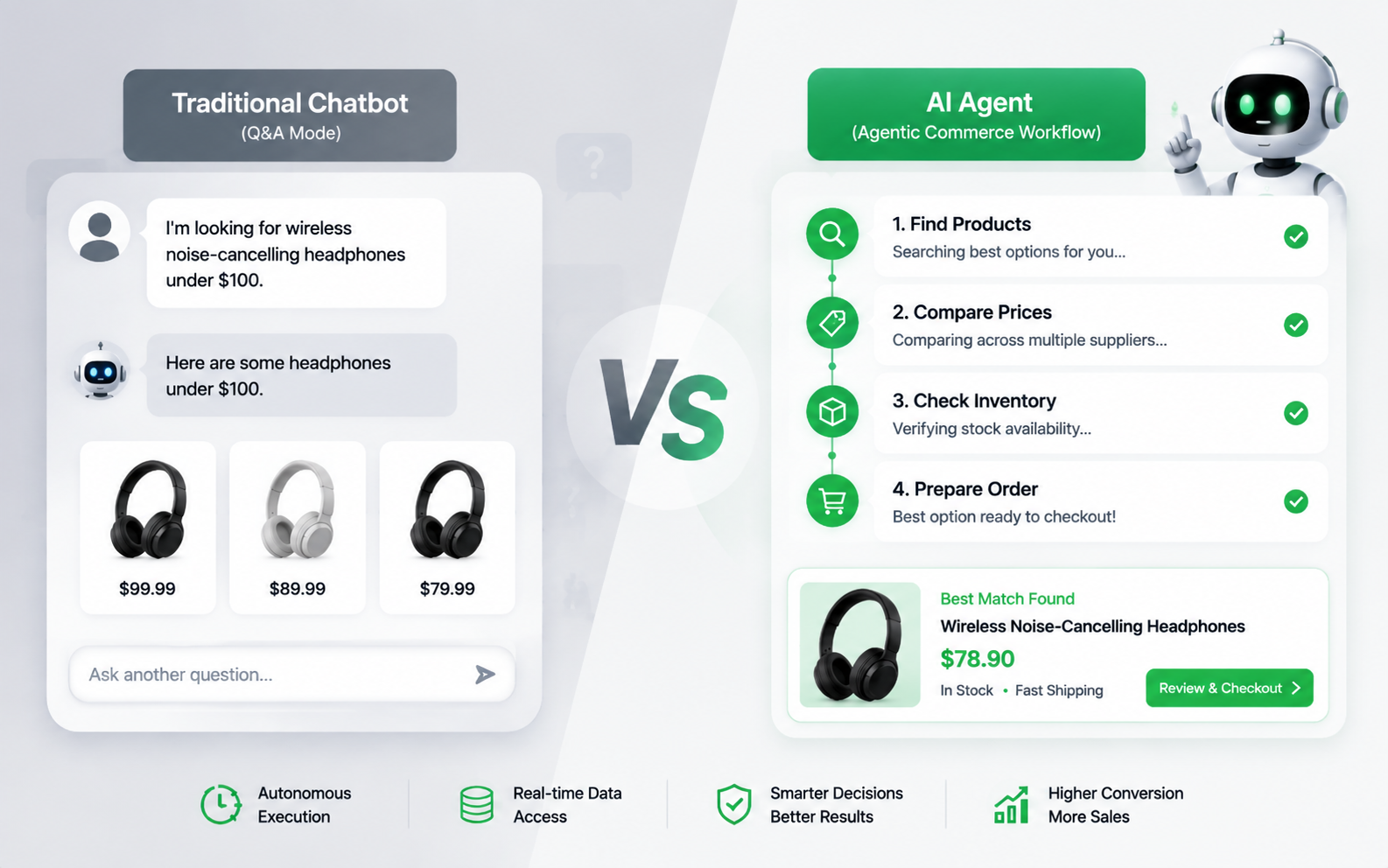
Chatbots Answer Questions; Shopping Agents Take Action
A chatbot may answer, “Do you ship to Germany?” An AI shopping agent may be asked to find a product that ships to Germany within a budget and delivery deadline. Where integrations allow, it can compare eligible variants, check availability, consider shipping terms, and direct the shopper toward checkout. The agent's role is outcome-oriented rather than limited to one question at a time.
For dropshippers, this means persuasive copy alone is insufficient. If a product page says “fast shipping” but supplies no destination-specific estimate, the agent has little dependable information to use. If a size is visible but its image, price, or stock status does not match the selected variant, the recommendation becomes risky.
How AI Agents Evaluate Stores Beyond Surface Marketing
AI-assisted shopping systems can work with comparable facts such as product identifiers, categories, materials, dimensions, colors, sizes, prices, availability, delivery estimates, return terms, and seller information. A vague phrase such as “premium best-quality bag” provides less decision value than “vegan leather crossbody bag, 22 cm × 16 cm × 7 cm, adjustable strap, zipper closure, available in black, beige, and brown.”
This does not mean every agent weighs the same signals or follows one published formula. Platforms differ in their data access and ranking systems. The safe strategy is to remove ambiguity, maintain consistent data, and make claims that the product and fulfillment operation can support.
The 4-Layer AI Commerce Readiness Framework
To ensure your storefront is easily interpretable by AI agents and large language models, structure your store around four core operational layers:
- Layer 1: Structured Product Data — Standardized SKU attributes, Schema.org product feeds, and distinct variant IDs.
- Layer 2: Merchant Trust & Identity — Clear refund terms, verified business contact information, and transparent policy pages.
- Layer 3: Live Fulfillment Reliability — Real-time API inventory telemetry and destination-specific delivery ranges.
- Layer 4: Brand Credibility — Consistent custom packaging, post-purchase tracking, and verified customer feedback loops.
Key Signals AI Shopping Agents Use to Rank Online Stores
There is no single public ranking formula for AI shopping agents. “Rank” in this context describes how a system may select or order eligible products using the data, relevance rules, merchant information, and user preferences available to it. The following signals are practical because current product-feed and merchant-listing systems already rely on them.
Standardized Product Attributes and Category Data
OpenAI's commerce product-feed specification includes identifiers, descriptions, pricing, availability, media, seller context, fulfillment options, and variant records. According to Google Search Central's product structured data documentation and Google Merchant Center guidelines, merchants are strongly encouraged to provide explicit product and merchant data, including brand, category, color, material, size, SKU, availability, shipping, and return information. Implementing structured data for product variants ensures that each selectable option maps directly to its correct image, price, and stock status.
Start with stable product and variant IDs. Use consistent category names. Separate color, size, material, dimensions, weight, compatibility, and care instructions into clear fields rather than hiding them inside supplier prose. Add GTIN, UPC, EAN, or MPN values where legitimate identifiers are available. Do not invent identifiers for products that do not have them.
| Catalog area | Weak setup | AI-ready improvement |
|---|---|---|
| Title | Hot sale fashion bag | Women's vegan leather crossbody bag with zipper |
| Variants | Mixed option names and duplicate SKUs | Unique SKU, image, price, and availability per variant |
| Shipping | Fast worldwide delivery | Processing and delivery estimates by destination |
| Availability | Manual, irregular updates | Synchronized stock status across feed, page, and checkout |
Live Inventory Telemetry and Fast Shipping Times
An agent cannot make a dependable recommendation when stock data is stale. OpenAI's product-feed guidance emphasizes current price and availability. Google requires availability to remain consistent across the data source, landing page, structured data, checkout, and shipping configuration. These are useful benchmarks even when a store is not directly connected to an AI shopping channel.
Separate processing time from transit time and publish realistic estimates for the shopper's destination. Fast shipping can be attractive, but accuracy matters more than a blanket promise. A slower option may still be the best match when it offers the right product, price, quality, or customization. The operational goal is to reduce stockouts, cancellations, and delivery surprises.
Verified Supplier Reliability and Branded Custom Packaging
Supplier reliability affects the facts shown on the storefront. Product quality, inventory stability, processing time, tracking updates, return handling, and packaging consistency all shape whether merchant promises remain accurate after an order is placed. Audit suppliers using samples, fulfillment records, defect patterns, tracking performance, and customer feedback instead of relying only on catalog claims.
Branded custom packaging can reinforce merchant identity and create a more consistent delivery experience. It is not a confirmed direct ranking factor for every AI shopping system. Its value is indirect but practical: clearer brand presentation, stronger customer recognition, and a physical experience that matches the store's positioning.
For dropshippers struggling with outdated inventory data and inconsistent fulfillment information, an integrated supply-chain platform can reduce manual updates between suppliers, stores, and customers. EPROLO helps merchants connect sourcing, fulfillment, tracking, and branding workflows within one operational system. Its branding page lists options such as labels, hangtags, packing bags, gift cards, and branded tape for eligible services. Merchants should confirm product eligibility, fees, processing impact, and destination details before promising a specific packaging experience.

How Dropshippers Can Prepare Stores for AI Shopping Step-by-Step
Clean Up Product Attributes and Variant Tables
- Audit the products that matter first. Start with the 20 to 50 products that generate the most traffic, revenue, or customer questions.
- Standardize titles and categories. Describe the product clearly and assign a specific category without keyword stuffing.
- Normalize attributes. Use consistent units and naming for materials, dimensions, colors, sizes, compatibility, and care.
- Repair variant records. Give every active variant a unique SKU, correct image, accurate price, stock status, and shipping eligibility.
- Remove unsupported claims. Replace “best,” “guaranteed,” or “medical-grade” language unless evidence and authorization support it.
- Validate structured data and feeds. Use the tools supplied by your commerce platform, Google Merchant Center, or the destination channel.
When importing products from EPROLO or another supplier catalog, treat supplier content as a starting point. Review titles, categories, images, variants, and descriptions before publishing. A fast import saves setup time, but store-specific catalog governance is what keeps the information accurate and consistent.
Connect Automated Supply Chain Data Feeds
Connect the product catalog, supplier inventory, order management, fulfillment, tracking, and customer-notification layers wherever reliable integrations are available. Automation should reduce the delay between a supplier change and the storefront update. It should also make exceptions visible instead of hiding them.
- Alert the team when high-volume products become unavailable or change price.
- Pause unstable products rather than allowing repeated cancellations.
- Monitor the time from payment to fulfillment and from shipment to tracking availability.
- Keep backup sourcing options for proven products, subject to quality and authorization checks.
- Review automated mappings after supplier catalog changes, because automation can distribute bad data faster.
EPROLO states that connected-store orders can synchronize to its dashboard and that it handles sourcing, packaging, fulfillment, and delivery after the merchant confirms and pays for the order. Tracking synchronization settings are also available. These capabilities can support an AI-ready operation, but the merchant still needs to monitor stock, product mappings, service eligibility, and customer-facing promises.
Upgrade Packaging Quality to Build Merchant Credibility
Start packaging upgrades with stable bestsellers rather than the full catalog. Test samples first. Compare the branding cost with product margin, confirm whether customization changes processing time, and check the delivered result. A logo sticker, thank-you card, label, or branded mailer can be a sensible first step when full custom packaging is not yet economical.
Use packaging to support truthful store identity and a useful post-purchase experience. Care instructions, support details, or a clear return pathway can add more value than decorative branding alone. The objective is consistency between what the store promises and what the customer receives.
Red Flags That Cause AI Agents to Skip Your Store
The following issues may make a product harder to select in AI-assisted shopping. They are not confirmed universal penalties, but each one creates uncertainty for an agent or a shopper.
- Thin supplier copy: generic titles, no measurements, missing materials, and no clear use case.
- Broken variants: duplicate SKUs, mismatched images, unavailable sizes, or inconsistent prices.
- Stale availability: products remain purchasable after the supplier runs out of stock.
- Opaque shipping: “fast delivery” without processing time, destination coverage, or estimated range.
- Weak trust pages: missing return terms, contact information, merchant identity, or support expectations.
- Unsupported claims: false authorization, unexplained sustainability language, or guarantees without evidence.
- Slow operational updates: delayed tracking, manual order routing, and unresolved fulfillment exceptions.
- Marketing and delivery mismatch: premium positioning paired with anonymous packaging or unreliable service.
Build an AI-Ready Supply Chain Network Today
An AI-ready store begins with controllable ecommerce fundamentals: accurate product records, stable suppliers, synchronized inventory, honest delivery estimates, clear policies, trackable fulfillment, and a brand experience that survives the final mile. These improvements help human shoppers today and reduce friction when agentic commerce becomes a larger discovery channel.
EPROLO can serve as a practical supply-chain option for merchants seeking product sourcing, connected order workflows, fulfillment, tracking, and branding support in one platform. It should not be presented as a shortcut to AI ranking. Its strategic value is helping a merchant improve the operational foundation that accurate AI shopping experiences depend on.
No supplier, app, schema plugin, or feed can guarantee placement inside AI shopping recommendations. Build for accuracy and reliability first. Then evaluate new commerce protocols and channel integrations as they become available to your store.
Frequently Asked Questions (FAQs)
What is an AI shopping agent in e-commerce?
An AI shopping agent is software that interprets a shopper's needs and helps with product discovery, comparison, evaluation, and, where supported, transaction steps. It may consider product attributes, price, availability, shipping, policies, seller context, and user preferences. Its capabilities depend on the platform and merchant integration.
How do AI shopping agents decide which store to buy from?
There is no universal public decision formula. An agent may use the user's request, catalog relevance, product attributes, price, availability, delivery options, seller information, return terms, reviews, and other accessible data. Merchants should focus on accurate, complete, and consistent information rather than speculative ranking tricks.
Why does fulfillment reliability impact AI store rankings?
Fulfillment reliability affects whether product availability, delivery estimates, tracking, and merchant promises remain accurate. While no universal agent-ranking rule has been published, dependable fulfillment reduces failed transactions and customer disappointment. Those outcomes support the trustworthiness of the product and merchant data used in shopping decisions.
Do small dropshipping stores need automated supply chains to stay competitive?
Small stores do not need enterprise infrastructure on day one. They should automate the highest-risk handoffs first, such as stock updates, order transfer, tracking, and customer notifications. A focused workflow for top-selling products can improve accuracy without adding unnecessary complexity. Human review remains important for exceptions and supplier changes.
Related Reading
- Is AI Dropshipping Legit? The Truth Behind E-commerce Hype in 2026
- 4 Best AI Tools to Automate Your Dropshipping Business in 2026
- The Ultimate Guide to Branded Dropshipping in 2026
- The Comprehensive Guide to Dropshipping Fulfillment in 2026
- How to Mitigate Shipping Delays in Dropshipping: A 2026 Guide to Keeping Customers Happy
Written by
Inverse
Inverse is a skilled Google SEO operations expert, with deep expertise in technical site audits, content clustering, and keyword strategy. Excelling at search engine visibility and organic traffic optimization, Inverse consistently delivers actionable insights across key search channels. This strategic approach helps e-commerce brands build sustainable organic traffic and expand their digital footprint effectively.
Editorial note:
This article was prepared using current public guidance from OpenAI's Agentic Commerce documentation, Google Search Central and Merchant Center product-data documentation, and EPROLO's official site and help content. Agentic commerce is evolving, and no universal AI shopping ranking algorithm is publicly documented. Merchants should confirm channel access, feed requirements, product eligibility, branding options, fees, and shipping conditions before implementation.