Selling on Poshmark in 2026 is one of the highest-margin routes into U.S. fashion e-commerce, with no paid ad spend and a bundled 20% commission structure. Flat-rate expedited shipping via USPS Priority Mail up to 5 lbs, plus a 10%+ price drop on Closet Clear Out days that Poshmark partly subsidizes, keep landed pricing predictable. This guide covers how to scale your multi-channel boutique past 50 orders/week utilizing an automated backend fashion supply chain without overstocking risk.
Key Takeaways
- Poshmark charges a flat $2.95 on sales under $15 and 20% on sales of $15 or more; the platform automatically manages transaction security and payment processing.
- Buyer-paid flat-rate shipping ($7.67–$8.27) up to 5 lbs via USPS Priority Mail keeps landed pricing highly competitive across the U.S. for heavy premium apparel.
- Closet Clear Out days reward a 10%+ price drop with a platform-subsidized shipping discount, a high-leverage lever for boutique sellers running flash drops.
- Integrating an on-demand wholesale fashion supply chain (like EPROLO) via your e-commerce hub turns Poshmark fulfillment into a streamlined multi-channel flow.
- Pricing cushions of 12 to 18% on top of landed wholesale cost keep private offers highly profitable while still looking generous to buyers.
Inside this article
- What Is Poshmark and Its Role in the Modern Fashion E-commerce Ecosystem?
- How Does Poshmark Work for High-Volume Boutique Sellers?
- Why Poshmark Is a High-Margin Channel for Fashion Boutiques
- How to Build an Automated Fulfillment Supply Chain for Your Poshmark Closet
- When to Set Strategic Pricing Cushions for Private Buyer Discounts
- Streamline Your Fashion Supply Chain Today
- FAQs About Poshmark Automation & Wholesale
What Is Poshmark and Its Role in the Modern Fashion E-commerce Ecosystem?
Poshmark is a U.S. social-commerce marketplace focused on fashion, founded in 2011 and operated as a curated closet format where individual sellers list new or pre-owned clothing and accessories. Unlike classic e-commerce stores where SEO and paid ads drive most traffic, Poshmark feeds discovery through a social graph: shares, follows, party rooms, and algorithmic recirculation of recently listed items. For fashion boutique operators, that structure turns the platform into a buyer intent machine; visitors are already filtering by size, brand, and style before they ever see a listing, which raises the average conversion rate above most paid-display channels for niche apparel.
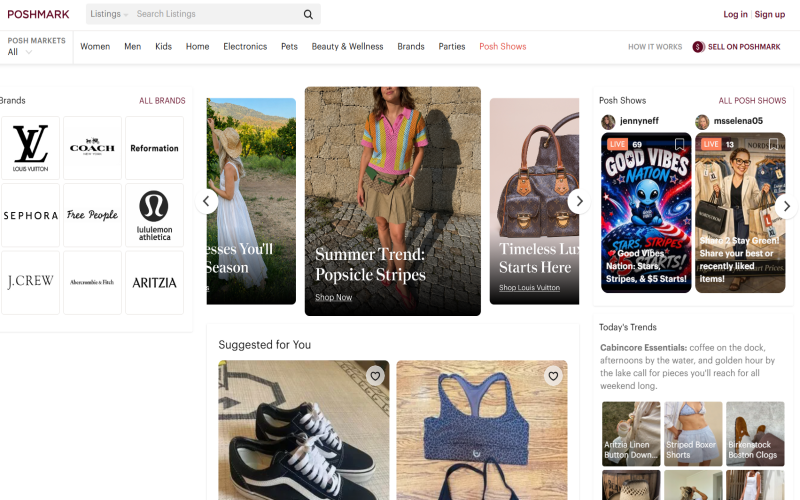
In the modern e-commerce mix, Poshmark plays three roles that a typical Shopify store alone cannot. First, it gives new boutiques access to a massive buyer base that already trusts the platform to handle payments and dispute resolution. Second, it acts as an ideal secondary channel where boutique owners can clear seasonal overstock or capsule pieces without burning brand equity on their main storefront. Third, with Poshmark's latest 2026 infrastructure updates—including real-time Sourcing Insights data and the automated Posh LIVE Studio dashboard—it works as an organic marketing extension, allowing boutique operators to amortize their wholesale apparel investments across multiple high-traffic destinations if back-office logistics and supplier-side operations are handled flawlessly.
How Does Poshmark Work for High-Volume Boutique Sellers?
The Poshmark order flow is simple by design. A buyer places an order, Poshmark charges the buyer's payment method, the seller receives a prepaid USPS Priority Mail shipping label, and the seller drops the package at any USPS pickup point. From a boutique operator's perspective, what changes at high volume is not the platform mechanics; it is the back-office work around listing creation, inventory synchronization, and fulfillment tracking. That backend workload is where smart automation, wholesale apparel sourcing, and multi-channel supply chain design become the difference between a 20-order closet and a 200-order pipeline.

How payments, commission, and shipping actually settle
Poshmark's fee structure is straightforward. For any sale under $15, the seller pays a flat $2.95 commission. For sales of $15 or more, Poshmark takes a 20% commission and the seller retains 80%. Standard shipping is paid directly by the buyer (currently a flat rate between $7.67 and $8.27 for packages up to 5 lbs shipped via expedited USPS Priority Mail). The seller does not pay for shipping unless they voluntarily offer a shipping discount to sweeten private buying offers.
What scales and what breaks above 50 orders/week
Below roughly 50 orders per week, a boutique can run a Poshmark closet with manual listings and small inventory at home. Above that volume, three processes need to change: listings should be synced from a single master SKU repository, inventory counts must tie directly to the core wholesale supply catalog, and order fulfillment should operate on an automated, on-demand routing basis. None of this is Poshmark-specific software; it is advanced supply chain design that treats Poshmark as one of several lucrative retail endpoints.
Why a single-channel boutique hits a ceiling
A boutique that treats Poshmark as its sole storefront caps its growth potential because the platform's social algorithm primarily rewards recency and internal engagements. A robust boutique architecture treats Poshmark as a powerful satellite channel alongside a primary Shopify store. This allows the business to amortize its wholesale apparel buys across multiple ecosystems and dynamically capture buyer demand without tying up capital in stagnant localized stock.
Why Poshmark Is a High-Margin Channel for Fashion Boutiques
The 20% headline rate covers payment gateway processing, structural customer support, and advanced marketing exposure. When backing those out of a traditional ad-spend acquisition model, Poshmark's cost of acquisition is highly competitive, supplying free organic audience traffic. Net margins on a $60 premium boutique apparel sale remain incredibly strong: a wholesale cost of $14 to $18 (around 25% of retail), leaving massive room for private-label customization and a highly predictable net profit margin when backed by a reliable no-MOQ wholesale apparel partner.
Where the platform fee structure sits

For professional sellers mapping out their multi-channel e-commerce footprints, evaluating the all-in transaction costs shows that Poshmark remains a highly strategic and cost-predictable engine for fashion apparel distribution:
| Platform | Headline Commission | Shipping Fee Payer | Effective Carrier Method |
|---|---|---|---|
| Poshmark | 20% (Sales $15+) | Paid by Buyer (Flat rate) | USPS Priority Mail (Up to 5 lbs); ideal for heavy winter apparel items |
| Mercari | 10% + Extra Fees | Variable (Buyer or Seller) | USPS Ground Advantage or FedEx; cost-effective for lightweight pieces |
| eBay | 13.25% + Fixed Fees | Variable (Calculated rate) | Carrier choice varies; complex tier pricing per weight zone |
Closet Clear Out and the shipping-discount lever
Closet Clear Out days reward any seller who drops their public listing price by 10% or more by triggering a Poshmark-subsidized shipping discount for buyers. For a boutique running highly structured capsule drops, this is an excellent conversion lever: you maintain your core profit calculations while the buyer receives an enticing shipping break fully subsidized by the platform, safely lifting short-term sales velocity.
Why order value matters more than order count
Below $15 in sale value, the flat $2.95 commission can compress margins on light low-ticket accessories. Above $40, the 20% tier easily covers operational allocations and leaves a healthy net boutique margin. Design your product catalog with this value distribution in mind: heavy on $40 to $120 premium dresses, premium outerwear, and structured bundles, avoiding low-value single items.
How to Build an Automated Fulfillment Supply Chain for Your Poshmark Closet
Poshmark backend scale doesn't rely solely on front-end sharing automation software. True business scalability resides in supply chain optimization: transforming order volume into a seamless, automated flow that functions flawlessly without requiring manual local storage or warehouse operations.
The four pieces of a professional boutique supply chain
- A no-MOQ wholesale supply catalog that offers on-demand logistics, enabling product listing expansion without large upfront stock investments.
- A single centralized SKU master sheet mapping every size, variant, and wholesale cost to ensure price consistency and easy cross-channel updates.
- Automated cross-listing tools that bridge product details from your master e-commerce storefront directly into peripheral marketplaces like Poshmark.
- Reliable blind-shipping fulfillment ensuring premium, unbranded packaging that protects your boutique's direct consumer relationship and brand integrity.
Why on-demand supply beats bulk buying
Buying 100 apparel units upfront locks up essential working capital immediately. If sales patterns fluctuate across specific sizes, you are left holding dead inventory and facing heavy markdown pressures. On-demand global supply sourcing flips this equation: customer orders pull inventory from the supplier catalog in real-time, keeping liquidity focused on high-yielding creative content, brand presentation, and market reach.

How the multi-channel integration works in practice
A forward-thinking fashion boutique today runs a frictionless multi-channel tech stack.
Step one: connect your primary Shopify or WooCommerce store directly with EPROLO to import a live catalog of trending designs with high-res photography and automated inventory syncing.
Step two: deploy cross-listing software (such as Vendoo or Flyp) to seamlessly push those EPROLO-sourced product listings from your Shopify hub onto your Poshmark closet.
Step three: when a sale occurs on Poshmark, fulfill the product via your EPROLO dashboard manually or through your connected e-commerce platform.
Step four: EPROLO's dedicated fulfillment center performs a strict quality audit, packs the items utilizing premium blind-shipping parameters to completely preserve your boutique's unique brand identity.
Where most catalog setups fail
The most common operational mistake is allowing marketplace listings to auto-share without monitoring underlying supplier inventory levels. Selling out-of-stock items leads to forced cancellations, which harms account standing. The optimal method is keeping your core e-commerce dashboard synchronized with the active supplier data stream, instantly propagating stock changes out to secondary sales endpoints like Poshmark to keep catalog data completely immaculate.
When to Set Strategic Pricing Cushions for Private Buyer Discounts
Poshmark's interactive offer ecosystem encourages negotiation, and the internal platform algorithm rewards active sellers who engage with customer offers. Rather than ignoring discounts, strategic operators build promotional flexibility into their initial pricing model. Establishing a structured pricing cushion of 12% to 18% above target margins allows you to seamlessly accept private buyer offers while remaining fully profitable.
The cushion math, written out
Suppose an on-demand fashion item features a wholesale landed cost of $16. To secure an optimal 30% net margin after platform fees and operational costs, your baseline retail target is $58. By integrating a 15% private offer pricing cushion, you establish a public listing price of $67. This structure enables you to accept a 10-15% private buyer discount gracefully, triggering the sale while preserving your exact baseline margin target.
When to give a deeper discount
Deeper price adjustments are highly effective in three specific business situations. First, during official Closet Clear Out days, where Poshmark absorbs buyer shipping incentives. Second, on multi-item buyer bundles, since unified USPS packaging under 5 lbs reduces marginal fulfillment effort. Third, on specific seasonal designs nearing a 60-day listing age, where liberating capital to redeploy into fresher catalog trends maximizes overall inventory turnover.
When to hold the line
Hold firm on your listed pricing for high-engagement capsule products that drive considerable traffic to your closet, items exhibiting high user interaction rates via comments and likes, and products where underlying base costs limit promotional flexibility. Declining a low-ball offer on a trending high-velocity product maintains brand value; accepting minor negotiations on slow-moving seasonal items maximizes liquidity.
Streamline Your Fashion Supply Chain Today
Building an optimized multi-channel fashion brand is entirely achievable with the right system. By establishing a centralized hub via Shopify or WooCommerce, linking an on-demand wholesale catalog, and distributing listings across secondary social commerce touchpoints like Poshmark using specialized cross-listing software, you create a scalable, modern retail ecosystem. This automated infrastructure empowers your boutique to clear 50+ orders a week effortlessly without localized overhead or complex physical storage barriers.
EPROLO is engineered precisely to support this multi-channel e-commerce growth. Providing a robust no-MOQ wholesale fashion catalog, global fulfillment, and reliable blind-shipping capabilities, EPROLO functions as your backend supply chain powerhouse. Connect EPROLO to your primary e-commerce storefront today to effortlessly scale your product offerings and manage global distribution without holding inventory.
FAQs About Poshmark Automation & Wholesale
What is the best automation for Poshmark?
The ideal automation stack involves a balanced three-layer approach. The first layer consists of app-level sharing tools that handle daily platform engagements like automated sharing and party returns. The second layer uses specialized cross-listing software (like Vendoo or Flyp) to duplicate and manage product data between your master store and secondary apps. The third, most vital layer is your core supply chain: integrating an on-demand wholesale catalog (like EPROLO) to your Shopify hub, which automates inventory adjustments and global order fulfillment without localized stock handling.
What's the trick to selling on Poshmark?
The true operational secret is implementing a disciplined pricing cushion combined with premium multi-channel supply sourcing. Listing items 12% to 18% above your net target margin allows you to accept private buyer offers smoothly without compromising your business bottom line. Pairing this price elasticity with platform promotions like Closet Clear Out days maximizes your overall sales velocity while keeping core profitability completely safe.
Why is it so hard to sell on Poshmark now?
The marketplace has transitioned into a highly value-driven ecosystem where buyers actively expect private negotiations and tailored promotions. Additionally, growing alternative platforms have distributed consumer attention. Success requires moving away from manual local storage and embracing lean, multi-channel supply chains. Scaling up product variety while eliminating localized storage risk enables boutiques to operate profitably inside modern margin conditions.
Who pays for shipping on Poshmark, and how do shipping discounts affect seller margins?
Buyers are responsible for paying the flat-rate shipping fee (ranging from $7.67 to $8.27) for any package up to 5 lbs on Poshmark. The platform automatically generates a prepaid USPS Priority Mail shipping label for the seller. Poshmark's 20% flat commission does not absorb or include this shipping label cost; rather, the buyer pays for it at checkout. However, during promotional events like Closet Clear Out, Poshmark may subsidize a portion of the shipping discount for the buyer if the seller drops the item price by at least 10%, effectively increasing conversion rates without further shrinking the seller's baseline margin.
How do I integrate a dropshipping/wholesale supply chain with Poshmark?
To integrate smoothly, use a centralized e-commerce storefront like Shopify as your primary hub. Connect your on-demand supply system (such as EPROLO) directly to your store to maintain strict inventory control. Next, use a dedicated cross-listing solution to synchronize these products into your Poshmark closet. When an order lands on Poshmark, fulfill the underlying product through your main dashboard, allowing your integrated supply chain partner to ship the order via premium, blind-shipping fulfillment directly to the consumer.
Related reading
- Is Poshmark Legit? What Sellers Need to Know in 2026
- White Label Dropshipping Risks: Avoid Brand Failure
- White Label Packaging: Boost Repeat Sales Instantly
- China Clothing Wholesale Market: Top 30 Sourcing Hubs
- Build a Branded Dropshipping Store With Zero Inventory
- Best Dropshipping Items: High-Margin Niches for 2026
Written by
Inverse is a skilled Google SEO operations expert, with deep expertise in technical site audits, content clustering, and keyword strategy. Excelling at search engine visibility and organic traffic optimization, Inverse consistently delivers actionable insights across key search channels. This strategic approach helps e-commerce brands build sustainable organic traffic and expand their digital footprint effectively.