Selling on Mercari in 2026 is the cleanest cross-channel option for U.S. fashion boutiques, with a flat 10% seller fee on item price plus buyer-paid shipping and no separate payment-processing fee. On a $50 order with $5 shipping, Mercari nets the seller $44.50 (since the 10% fee applies to the combined total), retaining a significantly higher net return compared to Poshmark's 20% straight cut ($40 net) at the same list price. This guide covers what Mercari is and the cross-border sourcing + automated fulfillment playbook that scales one apparel buy into multiple channel listings.
Key Takeaways
- Mercari's flat 10% seller fee (re-verified against Mercari Help on 2026-06-30) covers payment processing for new and updated listings, so there is no separate processing deduction on top of the 10%.
- A fashion boutique's $50 gross order (with $5 buyer shipping) nets $44.50 on Mercari vs Poshmark's $40 at the same list price, but Mercari's buyer base expects sharper deals than Poshmark's social-shopping audience.
- Cross-listing the same apparel catalog across Mercari, Poshmark, TikTok Shop, and a Shopify storefront is the strongest margin multiplier in 2026 — but it requires inventory sync to prevent double-selling.
- A wholesale apparel supplier that ships under blind-label packaging lets one order feed multiple channel listings without breaking brand integrity.
- A 7 to 14 day smart-pricing cadence (10% drop at day 14, 20% at day 28, bundle bump at day 30) is the highest-leverage velocity lever a fashion boutique has on Mercari.
- A multi-step overseas-vendor red-flag check (sample order, fit audit, defect log, IP complaint log) is the cheapest insurance against a sourcing trip that costs more in returns than it saves in unit price.
Inside this article
- What Is Mercari and How Does it Work for Fashion Sellers?
- Why Mercari Is a High-Margin Channel for Automated Fashion Boutiques
- How to Build a Cross-Border Marketplace Sourcing Strategy for Mercari Clothes
- How to Integrate Automated E-commerce Fulfillment with Your Mercari Store
- When to Set Strategic Pricing Cushions and Smart Optimization Promos
- Dominate the Reseller Market with Agile Supply Chains
- Sourcing Red Flags: Escaping the Low-Quality Overseas Vendor Trap
- Scale Your Digital Apparel Architecture Today
- Frequently Asked Questions About Mercari Automation & Apparel Sourcing
What Is Mercari and How Does it Work for Fashion Sellers?
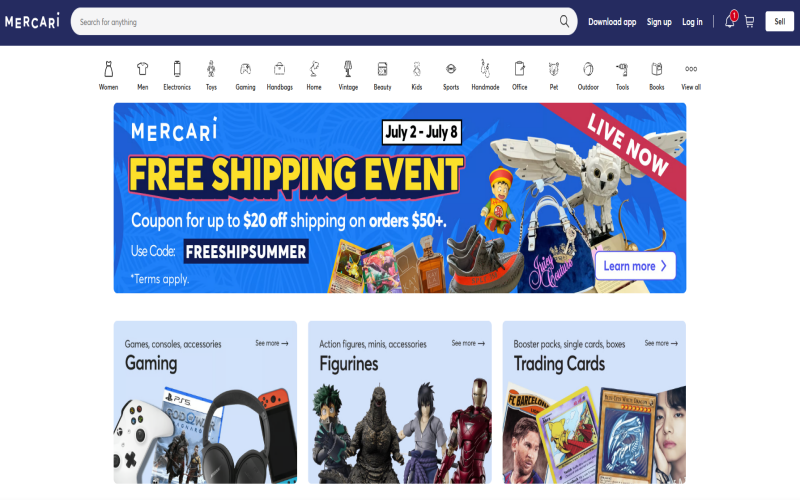
Mercari is a horizontal resale marketplace launched in Japan in 2013 and operated in the U.S. since 2014, where individual sellers list new or pre-owned items across all categories and the platform handles payment, identity, and shipping-label logistics. Compared with social-commerce marketplaces like Poshmark, Mercari leans closer to a low-friction eBay experience: there are no party rooms, no social-follow graph, and buyer discovery is driven by search relevance and the platform's recency algorithm rather than share-and-lurk. For fashion boutique operators, that distinction shapes two important behaviors. First, Mercari rewards strong, keyword-rich listings and clear front-of-garment photography over volume-sharing. Second, it pays out earnings more passively , funds are released three days after delivery confirmation, with no platform-managed interactions required in between.
In the U.S., Mercari draws a deal-oriented buyer base that expects sharper prices than Poshmark's fashion-forward audience, which is why net-net per-order dollar figures often favor Mercari (the 10% fee is half of Poshmark's 20%) while per-listing time favors Poshmark (Mercari's algorithm rewards detail pages more than re-share velocity). For a boutique operator choosing channels, the way to thread that needle is to list the same apparel on both platforms, run a search-optimized detail page on Mercari, and use Poshmark as the share-and-engage surface where the algorithm rewards activity. Mercari's role in that arrangement is the low-fee cash-flow engine; Poshmark's role is the brand-building discovery surface.
Why Mercari Is a High-Margin Channel for Automated Fashion Boutiques
The 10% seller fee on Mercari is one of the simplest fee structures in U.S. resale, and that simplicity is the channel's biggest margin advantage. On a $50 order with $5 buyer-paid shipping, Mercari's flat 10% takes $5.50 , there is no separate payment-processing charge on the seller's side and no per-order fixed fee. The same $50 order on Poshmark takes $10 (20% bundled commission, which includes the USPS label) and roughly $5.40 on eBay (final-value fee plus per-order fee). Mercari wins the fee battle for sellers who list $30 to $150 fashion pieces without bundled shipping labels. The math inverts only when shipping is bundled into the sale price; on those free-shipping listings, Mercari still takes 10% of the sale total, and the seller's shipping cost comes out of pocket separately.
The fee-structure puzzle: $2.95 + 20% vs 10% flat
Poshmark's $2.95 flat fee for items under $15 looks cheaper in headline rate for ultra-low-value pieces, but the moment a fashion boutique sells a $25 t-shirt or a $60 dress, the 20% commission on Poshmark overtakes Mercari's 10%. Mercari also earns the high-margin label on its payout timing: Mercari releases earnings three days after delivery confirmation, which keeps the boutique's working-capital cycle tighter than the four-to-five-day window common on other resale platforms. For a boutique processing $4,000 a week in Mercari orders, that day or two faster release on average is the difference between holding and not holding a short-term working-capital line.

What about the 3.6% Buyer Protection fee?
| Marketplace Platform | Seller Commission Fee | Payment Processing Fee | Buyer-Side Fees | Payout Velocity |
|---|---|---|---|---|
| Mercari (2026 Standard) | 10% (Item Price + Shipping) | $0 (Eliminated) | 3.6% Buyer Protection Fee | 3 Days After Delivery |
| Poshmark | 20% Flat Rate | Included in Commission | $0 (Standard Shipping Paid) | 4-5 Days on Average |
| eBay (Fashion Cat.) | ~13.25% - 15% Standard | +$0.30 to $0.40 Per Order | $0 (Sales Tax Only) | Daily / Weekly Batches |
Mercari charges a 3.6% Buyer Protection fee on the buyer's side of checkout , so the buyer pays it, not the seller. It does, however, function as a soft conversion lever. Buyers who notice the Buyer Protection fee at checkout sometimes reduce their offer by that amount to compensate, which forces a smarter listing price strategy: the boutique lists at the price floor they will actually accept, not the price ceiling the buyer is willing to pay. Done well, accounting for the Buyer Protection fee in advance keeps margins inside the 25%+ zone for $30 to $80 wholesale-cost fashion pieces.
The catch: Mercari's buyer base expects deals
Mercari's higher margin comes with one binding trade-off. Compared with Poshmark's audience, Mercari's buyers price-anchor more aggressively, expect free shipping or pay the 3.6% Buyer Protection fee at checkout, and leave messages asking "would you take $X?" within hours of a listing going live. A boutique that lists at the same retail price on both platforms will see Mercari sell-through at roughly 70% of the rate it sees on Poshmark, which means Mercari volume needs a steeper discount than Poshmark to clear the same gross. Pair Mercari's lower fee with a 12 to 18% permanent discount off retail and the per-listing margin starts to compound across catalog breadth.
How to Build a Cross-Border Marketplace Sourcing Strategy for Mercari Clothes
A cross-border marketplace sourcing strategy means treating your apparel catalog as a single inventory pool that gets listed across multiple marketplaces in parallel, so that one supplier relationship feeds every channel you sell on. The strategy has three layers: a single SKU master sheet that lists every style, color, and size you carry; a per-channel allocation rule that decides how many units of each SKU go to Mercari vs Poshmark vs TikTok Shop vs Shopify on a given listing cycle; and a buffer-stock rule that keeps at least one unit of each hero SKU on standby for re-listings and replenishment.

The single-SKU-master approach
Pull a single CSV from your wholesale apparel supplier that lists every style, photograph, color, size, weight, and wholesale price. That file feeds every channel listing format (Mercari's listing template, Poshmark's share-popup, TikTok Shop's product card, Shopify's product API), so the boutique is not rewriting descriptions four times. Done manually, this approach is fragile; done with a supplier API endpoint or a daily CSV pull, it scales to 200+ SKUs without a single-channel bottleneck.
Allocation rules and the double-selling trap
The double-selling trap is the failure mode that catches boutique operators who expand from one marketplace to many. You list the same dress on Mercari and Poshmark. Both listings sell. You ship the first order, then ship a duplicate from your supplier at the second marketplace's higher cost. The cleanest fix is to allocate per-SKU inventory , Mercari gets 3 units, Poshmark gets 3, the remaining stock sits in a "cross-list" pool that goes live the moment either channel's allocation hits zero. Allocation can live in a Google Sheet at small scale, in a Shopify inventory sync at medium scale, and in the supplier's own API at large scale.
What makes a fashion dropshipping supplier worth partnering with
Three traits separate a wholesale apparel partner worth scaling with from a transactional sourcing trip. First, the supplier publishes a stable SKU feed with photographs that hold up for at least 18 months without re-shoots. Second, the supplier offers blind-label packaging , the package the buyer opens looks like your boutique's own shipping rather than a third-party fulfillment house. Third, the supplier's per-unit wholesale cost stays inside the 25 to 35% retail band the brief walked through earlier, so Mercari's 10% fee plus the 3.6% buyer-side friction still leaves a 25%+ boutique margin on most catalog pieces. A supplier that hits all three enables Mercari to be one of three or four parallel channels rather than a standalone storefront.
How to Integrate Automated E-commerce Fulfillment with Your Mercari Store
Mercari automation has two different meanings that often get conflated. The first meaning is listing automation , third-party tools that generate Mercari titles, descriptions, and listing photos from a master SKU sheet, then push the listing live without manual copy-paste. The second meaning is fulfillment automation , a routing rule where each new Mercari order triggers an immediate pick-and-pack job at the wholesale supplier, generating a USPS/UPS/FedEx label and tracking number back to the buyer without the boutique manager touching the package. The second is what turns Mercari from a time-consuming side channel into a real revenue channel.
The four-handoff automated-fulfillment pattern
- Listing sync. A pull of the supplier's SKU feed daily, with new SKUs auto-listed on Mercari at the boutique's chosen retail price and 12 to 18% discount cushion.
- Order routing. A trigger that watches the Mercari order inbox and, on each new order, creates a fulfillment job at the supplier with the SKU, buyer address, and a Mercari-prepaid label or the supplier's own carrier label.
- Inventory reconciliation. A nightly pull that decrements allocation across every channel where the SKU was listed, so the same dress does not appear live on two marketplaces in two different quantities.
- Tracking loop. A webhook that pushes the carrier tracking number back to Mercari and updates the order as "shipped" without the boutique manager retyping a tracking string.
Why pre-paid labels matter and when to override them
Mercari offers a $5.49 standard prepaid label and a $4.59 best-rate prepaid label for most X-Small, Small, and Medium packages in 2026, with USPS Priority Mail and UPS Ground Saver rates scheduled to take a USPS fuel-surcharge adjustment in May 2026. For typical fashion boutique items under 1 lb, the best-rate prepaid label is cheaper than paying retail carrier rates. The exception is heavy or oversized items , above 5 lb, a boutique's own UPS account can undercut the prepaid label by $2 to $5 per order, so the routing rule should default to "Mercari-prepaid label for items under 5 lb, boutique's own UPS account for anything heavier."
Where most Mercari automation setups go wrong
The single most common failure is letting the listing-sync pull run too often. If the supplier's feed updates every hour and the boutique's listing tool re-imports every hour, Mercari's algorithm interprets the constant listing churn as gamed behavior and reduces the listing's search ranking. The safer pattern is a daily refresh cycle that pulls the supplier's stock counts once, decrements the inventory locally, and only re-lists SKUs whose stock count has changed. That one rule keeps Mercari's algorithm friendly while still protecting the boutique against double-selling.
When to Set Strategic Pricing Cushions and Smart Optimization Promos
Smart pricing optimization on Mercari is the timing dimension that turns discount cushion into predictable sell-through cadence. The mechanics: list at a price 12 to 18% above the true retail target, then run a 7 to 14 day price-shrink schedule that drops the price by 10% at day 14, another 10% at day 28, and a free-shipping bonus at day 30. Each step widens the search ranking and the buyer engagement enough to push the listing's recency signal up without producing the auction-floor vibe that targets reject. Done right, a $40 wholesale apparel piece listed at $69 (12% cushion) clears the catalog at roughly $58 to $62 net within 28 days, which lands above the boutique's 25% margin target even after Mercari's 10% fee.
Day-by-day pricing tiers that work
For a typical boutique apparel item in the $30 to $150 list range, three price tiers are enough. Tier 1 (day 0 to 14): list at the highest price the market will accept, typically the manufacturer's MSRP or the boutique's own retail, and let the discount cushion sit below. Tier 2 (day 15 to 28): drop by 10%, send a "make offer" auto-response, and the listing's recency signal pushes it back to the top of Mercari's search results. Tier 3 (day 29+): drop by another 10%, convert to free shipping, and accept any offer above landed-cost-plus-margin. The shelf time under that cadence is roughly 35 days, and the inventory turnover is fast enough to free working capital for the next capsule.
When smart optimization devolves into a race to the bottom
The temptation after a slow month is to skip straight to tier 3 on day 7 to chase quick volume. Don't. Mercari's algorithm reads aggressive early discounting as a quality signal in reverse and quietly reduces the listing's search ranking for the next 60 days, which makes future clearance events more expensive. The cheaper lever is to pull the listing, refresh the photographs with a new outfit stack, and re-list at the original tier 1 price. Mercari's recency boost on a refreshed listing is usually larger than a 20% price drop on a tired one.
When to bundle or, alternatively, when to break a bundle
Bundle slow-movers with hero SKUs at day 20 to clear two SKUs in one transaction. Hold off on bundling until each piece has spent at least 14 days solo; Mercari's buyers will pay for a bundle because they save shipping cost (single label is cheaper than two), but they will not pay for a bundle they could have bought individually at a discount. If you list the hero at a discount while bundling the slow-mover at full price, the bundle margin matches what solo discount-cleared inventory would have done.
Dominate the Reseller Market with Agile Supply Chains
Reseller dominance in 2026 is not about the cheapest unit price; it is about the shortest cycle time between identifying a trend and shipping a relevant listing. The agile supply chain that wins looks like three pieces.
First, a SKU watchlist that tracks the boutique's category-level lead indicators: TikTok hashtag volume, Pinterest trend rankings, Mercari sold-listings velocity for the past 14 days, and the supplier's stock counts.
Second, a 48-hour listing turnaround from trend detection to listing live, which is impossible with bulk-buy sourcing and easy with no-MOQ wholesale apparel.
Third, a 96-hour order turnaround from order notification to shipping label scanned, which forces a supplier-side or local-warehouse fulfillment model rather than a 7 to 14 day bulk-buy model.
A boutique running an agile supply chain at $2,000 weekly volume will out-ship a $4,000 weekly bulk-buy boutique within six months, because the agile operation has fresh inventory turning over quickly while the bulk operation sits on a warehouse of last season's colors. The math of inventory carrying cost adds up faster than most sellers expect: a $4,000 weekly bulk-buy inventory represents roughly $16,000 in working capital tied up at any moment, while an agile operation needs closer to $3,000 to operate at the same weekly volume.
Sourcing Red Flags: Escaping the Low-Quality Overseas Vendor Trap
A low-quality overseas vendor trap looks attractive on the first quote but bleeds the boutique's margin over the next six months through return rates, defect rates, and customer-service overhead. The escape route is a four-step vendor qualification check that runs before any $1,000 or larger order, and is mandatory before any blind-label partnership. The cheapest version of this check costs about $300 in sample fees and 10 hours of operator time, which is less than a single week of returned-Mercari-orders will cost the boutique at scale.

Red flag 1: No proprietary photograph library
A vendor who can only send a single dress-on-hanger studio shot, or who borrows photographs from another supplier's catalog, has not yet built the kind of inventory depth that a wholesale apparel partner requires. A 200-SKU catalog demands a base image library of at least five shots per SKU (front, back, side, detail, packaging). If the vendor can deliver one shot per SKU on request and "more on file" only after payment, walk away. Listings built on borrowed photographs do not survive Mercari's first listing-quality audit.
Red flag 2: No published defect rate or sample-order policy
A vendor who refuses to disclose a defect rate (the share of shipments that arrive damaged or wrong) or who refuses to ship a paid sample before bulk-buy is operating as a transactional supplier, not a wholesale apparel partner. The boutique's return-rate target is under 2% per SKU; if the vendor cannot show evidence of sub-2% performance, the boutique will absorb the difference through Mercari's buyer-complaint pipeline. That is the wrong place to learn whether a vendor's products hold up.
Red flag 3: Inability to ship under blind-label packaging
A vendor who insists on shipping in their own branded mailer or who refuses to put the boutique's branding on the inner packaging is forcing the boutique into a one-channel operation. Blind-label packaging is the cheapest way to make a cross-border marketplace sourcing strategy possible, because the same parcel can be sold on Mercari, Poshmark, TikTok Shop, or a Shopify storefront without revealing the upstream supplier. Without blind-label, the supplier's brand identity leaks into the buyer's experience on every channel, which destroys the wholesale fashion boutique's positioning.
Red flag 4: Unverified or copied designs
A vendor who resells inventory lifted from independent designers, or who cannot show original artwork files for printed apparel, exposes the boutique to IP complaint risk. Mercari and major marketplaces suspend sellers with active IP disputes, and the boutique's recovery cost (reinstatement fees plus lost catalog exposure) usually exceeds the unit-price savings. Verify the vendor's design provenance on the first sample order; the time spent now is the cheapest insurance against a future infringement lawsuit.
The 48-hour vendor qualification workflow
Compress the four red-flag checks into a 48-hour workstream.
Day 1 morning: email the vendor for the SKU list, photograph library, sample-order policy, and blind-label packaging options. Day 1 afternoon: book a 30-minute video call to verify the photographs match the inventory and watch for the cues that distinguish a working wholesale partner from a transactional reseller.
Day 2 morning: place a $300 paid sample order covering three SKUs that touch each of the boutique's main categories, then schedule a day 2 afternoon followup to inspect the sample for fit, fabric weight, and packaging integrity. The vendor passes or fails within 48 hours, and the boutique has spent less than what a single week of bad Mercari reviews will cost.
Scale Your Digital Apparel Architecture Today
Below is a 14-day rollout plan for launching a Mercari channel on top of an existing wholesale apparel supply chain.
Day 1 to 3: pull the supplier's master SKU sheet and select 30 to 60 hero pieces that map to the boutique's top three categories; load each piece into a single allocation table with Mercari receiving 3 units, Poshmark receiving 3, and the remaining units sitting in a cross-list pool.
Day 4 to 7: list on Mercari with strong keyword-rich titles, two front-of-garment photos, and a 12 to 18% discount cushion; mirror those listings on Poshmark with social-friendly descriptions.
Day 8 to 10: stand up the four-handoff automated-fulfillment pattern and verify that the inventory sync runs once nightly rather than hourly.
Day 11 to 14: monitor Mercari's algorithm response to the new listings and run your first day-14 price tier-2 drop on the slow-mover half of the catalog. By day 14 the boutique has a working Mercari channel with measurable week-over-week sell-through, and the same wholesale apparel buy continues to amortize across more sales surfaces than the original boutique store ever reached.
EPROLO was built for the workflow above: no-MOQ wholesale apparel sourcing, blind-label packaging as a default rather than an add-on, and supplier-side fulfillment that integrates with both Mercari and Poshmark order notifications on a single inventory pool. Register on EPROLO with a free account, pull the master SKU feed, and a Mercari channel goes live within a week.
Frequently Asked Questions About Mercari Automation & Apparel Sourcing
Is it safe to buy from Mercari?
Yes, Mercari is a safe marketplace to buy from as of 2026 if the buyer follows the platform's recommended purchase flow. The Mercari Buyer Protection fee — 3.6% charged at checkout , funds a guarantee that returns the buyer's payment if an item arrives damaged, significantly different from what was listed, or never arrives, provided the transaction stays inside Mercari's checkout system. The risk most buyers face is engaging sellers off-platform, which removes the protection. From the seller's side, Mercari's safety story is also strong: payout is held until the buyer confirms the item (or three days pass after delivery confirmation), which is faster than some peer marketplaces but slower than instant-pay options. A fashion boutique operating within Mercari's checkout and shipping-label system faces very low fraud risk because the platform verifies identity on both sides of the transaction.
Why is stuff so cheap on Mercari, and can premium items still sustain high margins?
Stuff tends to be cheaper on Mercari for two reasons. First, the buyer base expects sharper prices, so listings naturally settle around 10 to 20% below the comparable Poshmark list price. Second, Mercari's flat 10% seller fee is roughly half of Poshmark's 20%, which lets sellers post slightly lower retail prices and still clear similar margins in absolute dollars. Premium items — $80 to $200 wholesale fashion pieces sourced through EPROLO's apparel supply chain — can sustain healthy margins on Mercari because the 10% fee scales linearly. For instance, a $120 wholesale item listed at $189 on Mercari earns $170.10 after the 10% platform fee, yielding a clean 26.5% net gross margin, representing a substantial 41.7% markup over your initial wholesale product cost. The catch is that premium items also clear slower on Mercari than on Poshmark's audience, so the boutique has to run a 14-day pricing tier schedule and accept that high-ticket items will sit slightly longer before selling.
Which is better for an automated fashion boutique, Poshmark or Mercari?
Neither marketplace is universally better; the right channel depends on the boutique's category mix and staffing model. Mercari is the better choice when the boutique sells $30 to $150 apparel at higher margins (the 10% fee beats Poshmark's 20% on most pieces), wants faster payout cycles (3 days vs 4 to 5 days on average), and lists through a search-optimization heavy workflow. Poshmark is the better choice when the boutique sells community-driven fashion (streetwear, occasion wear, capsule drops) and has staff time to dedicate to daily share-and-follow engagement. For most automated fashion boutiques, the productive answer is "both": Mercari as the low-fee revenue engine, Poshmark as the brand-building discovery surface, and the same wholesale apparel supplier feeding both channels with a single SKU master sheet and allocation rules that prevent double-selling.
How do I integrate a dropshipping supply chain with Mercari without double-selling risks?
To integrate a dropshipping supply chain with Mercari without double-selling risks, sellers must deploy three unified inventory controls. First, establish dedicated SKU cross-channel allocations, reserving specific safety stock limits across Mercari and Poshmark. Second, sync multi-channel nodes via central automated hubs. By utilizing automated platforms like EPROLO’s native inventory sync engine, stock shifts from your cross-border clothing manufacturers are reconciled seamlessly overnight to prevent tracking lag. Third, enforce closed-loop order routing by passing both the marketplace order ID and custom SKU tags directly to the packaging line, ensuring your automated fashion fulfillment remains error-free while scaling multi-channel velocity.
What is the best smart pricing optimization interval to clear clothing inventory?
The best smart pricing optimization interval for clearing clothing inventory is 7 to 14 days per tier with three price drops before the listing goes into a final bundle stage. Run tier 1 (full retail) for the first 14 days so the listing ranks on its own strength. Drop by 10% at day 14 to refresh Mercari's recency signal and target the second wave of search interest. Drop by another 10% at day 28 and convert to free shipping to convert serious buyers who were waiting. By day 30, bundle the slow-mover with a hero SKU to clear both items in one transaction. This interval typically clears 70% of new apparel listings within 35 days, which is fast enough to free working capital for the next capsule while preserving the boutique's margin curve.
Related reading
- Is Mercari Legit? A 2026 Guide
- China Clothing Wholesale Market: Top Sourcing Hubs (2026 Guide)
- White Label Packaging: Boost Repeat Sales Instantly
- How to Build a Branded Dropshipping Store Without Holding Inventory
- Top Dropshipping Products: High-Margin Niches for 2026
- The Brutal Truth: 10 Pros and Cons of Dropshipping
Written by
Inverse is a skilled Google SEO operations expert, with deep expertise in technical site audits, content clustering, and keyword strategy. Excelling at search engine visibility and organic traffic optimization, Inverse consistently delivers actionable insights across key search channels. This strategic approach helps e-commerce brands build sustainable organic traffic and expand their digital footprint effectively.
Editorial note: The Mercari seller fees, shipping structures, and carrier data (including recent USPS fuel surcharges) outlined in this article reflect publicly verified marketplace standards as of July 2026. Similarly, EPROLO platform features—such as our no-MOQ wholesale clothing supply, blind-label packaging, and automated multi-channel routing—reflect our active software capabilities at the time of publication. Because marketplace fees and carrier label rates fluctuate frequently, we strongly recommend auditing current rates inside your Mercari seller dashboard and EPROLO account before scaling your multi-channel storefront. Individual business results, sell-through rates, and order volumes are not guaranteed.