BigCommerce and Shopify both provide hosted ecommerce infrastructure, storefront tools, checkout, inventory management, and app integrations, but they package those capabilities differently. Shopify emphasizes a fast setup experience, a broad app ecosystem, and accessible dropshipping connections. BigCommerce puts more catalog, promotion, payment, and multichannel functionality into the core platform, which can reduce reliance on add-ons for some merchants.
There is no universal winner because the right choice depends on payment-provider availability, sales volume, catalog complexity, team skills, and the apps required for sourcing and fulfillment. This BigCommerce vs Shopify comparison reviews current 2026 pricing, payment fees, usability, built-in tools, SEO controls, and dropshipping workflows so you can compare the likely operating cost and choose a platform that fits the way your business actually runs.
Key Takeaways
- Headline Pricing vs. Real Costs: Both platforms start at $39/month ($29 on annual billing), but BigCommerce enforces sales-volume (GMV) thresholds, whereas Shopify costs scale primarily through paid third-party app subscriptions.
- Transaction Fee Differences: Shopify waives extra transaction fees only when using Shopify Payments, while BigCommerce charges 0% transaction fees on 20+ embedded gateways but may assess fees on open payment processors.
- App Ecosystem vs. Native Depth: Shopify offers intuitive onboarding supported by thousands of specialized apps, while BigCommerce builds extensive catalog, promotion, and multichannel capabilities directly into the core engine.
- Dropshipping Integration Advantage: Shopify remains the preferred environment for dropshippers due to direct, seamless integration with key platforms like EPROLO, whereas BigCommerce features a smaller supplier app ecosystem.
- SEO Control: Shopify provides reliable, automated technical SEO foundations for straightforward stores, while BigCommerce allows deeper URL hierarchy and robots.txt customization for complex or enterprise catalogs.
Table of Contents
BigCommerce vs Shopify at a Glance
| Feature | Shopify | BigCommerce |
|---|---|---|
| Pricing | Basic $39 monthly or $29 monthly on annual billing | Core $39 monthly or $29 monthly on annual billing; GMV thresholds apply |
| Payment & Transaction Fees | No third-party transaction fee when Shopify Payments is the sole provider; plan-based fees can apply otherwise | No BigCommerce order fee with 20+ embedded providers; plan-based Open Payment Provider fees can apply |
| Ease of Use | Beginner-friendly setup and a guided admin | More configuration depth and a steeper learning curve |
| Built-in Features | Strong core platform, often extended with apps | Broad native catalog, promotion, review, and multichannel tools |
| Apps | Large ecosystem with thousands of integrations | More than 1,200 apps, with fewer dropshipping choices than Shopify |
| SEO | Automatic technical basics plus editable titles, descriptions, URLs, and alt text | Strong URL, metadata, redirect, robots, sitemap, and storefront controls |
| Dropshipping | Excellent app coverage, including the EPROLO Shopify app | Supported through apps such as Spocket, Doba, Syncee, and POD services |
Shopify is positioned as the easier ecosystem-led option. BigCommerce is positioned as the feature-rich core platform for merchants who want more functionality included before installing extra apps.
BigCommerce vs Shopify Pricing
At the base-plan level, the two platforms now line up closely in the United States. Shopify lists Basic, Grow, and Advanced at $39, $105, and $399 per month, or $29, $79, and $299 per month with annual billing. BigCommerce lists Core, Growth, and Scale at the same monthly and annual-equivalent prices. The major difference is that BigCommerce ties self-serve plans to gross merchandise value thresholds. Core covers up to $30,000 in trailing-12-month GMV, Growth up to $100,000, and Scale includes $33,333 in monthly GMV before a 0.9% overage.
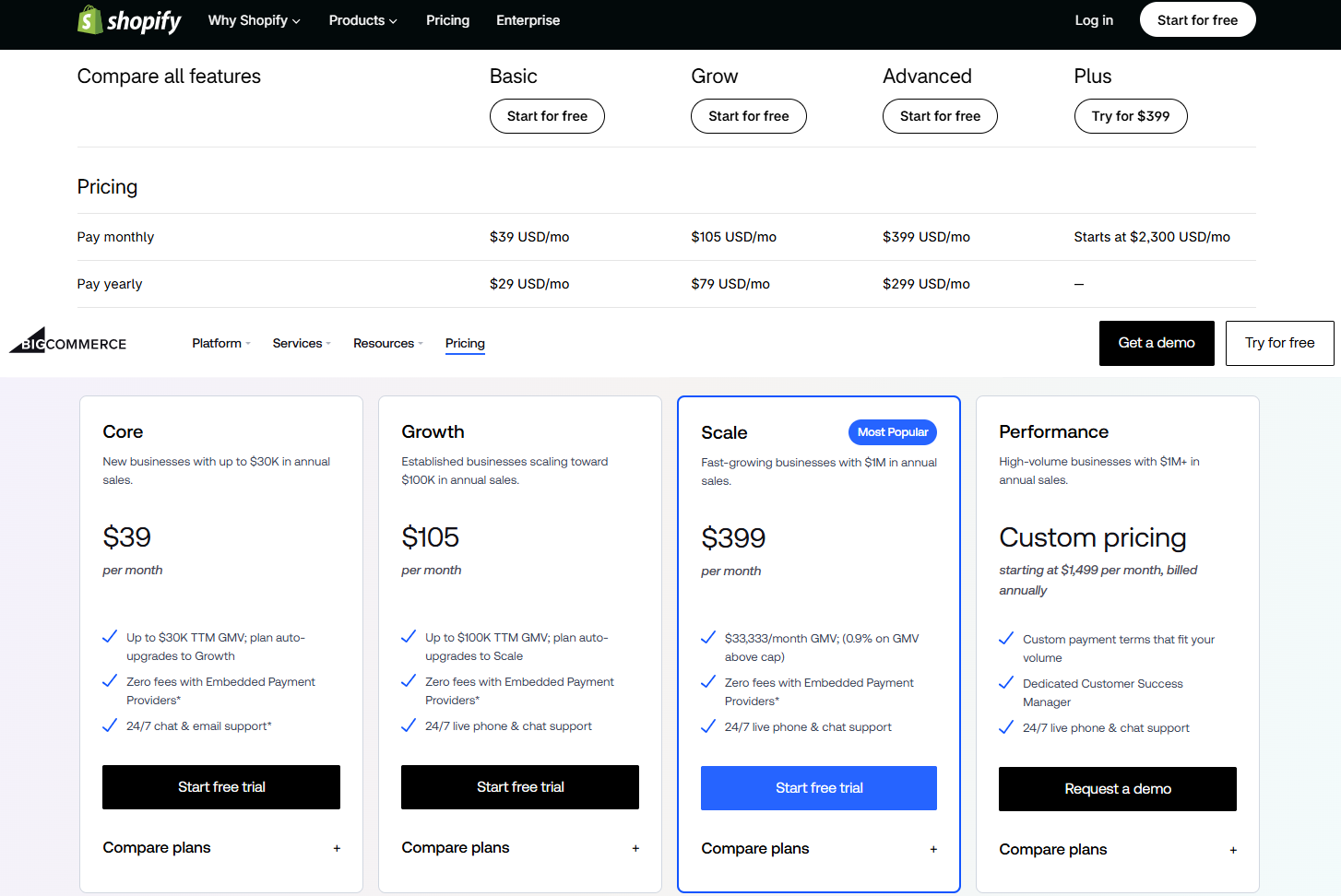
Payment costs need careful comparison. Shopify waives third-party transaction fees when Shopify Payments is the sole provider, while card-processing rates still apply. If another processor is used, Shopify lists plan-based transaction fees. BigCommerce charges no additional order fee for transactions handled by its 20-plus Embedded Payment Providers, but 2026 self-serve plans can incur Open Payment Provider fees of 2%, 1%, or 0.6%.
Apps can change the real monthly bill on either platform. Shopify merchants may add paid tools for sourcing, subscriptions, reviews, or advanced workflows. BigCommerce includes more functions natively, yet dropshipping apps such as Doba, Spocket, or Syncee can add roughly $29 to $39 or more per month. Always total subscription, processing, provider, app, shipping, and GMV-related costs.
Bottom line: identical headline plan prices do not produce identical operating costs.
BigCommerce vs Shopify: Features and Ease of Use
Shopify is generally easier for a new merchant to start using. Its setup flow, theme editor, product screens, checkout configuration, and app installation process are designed around guided decisions. A solo operator can move from account creation to a functional storefront without first learning a large set of catalog or channel settings. Shopify also offers a broad integration ecosystem, so merchants can add specialized functions as their requirements grow. That convenience has a cost trade-off: a workflow that looks simple at launch may accumulate several recurring app subscriptions later.
BigCommerce presents more operational controls inside the platform. Its current plan pages list unlimited products, staff accounts, real-time shipping quotes, product ratings and reviews, coupons, discounts, gift cards, a built-in blog, professional reporting, multi-currency support, and marketplace connections. It also provides substantial native catalog, inventory, promotion, and multichannel functionality. This can reduce the number of paid add-ons needed for a complex catalog, but the admin can feel denser because more options are exposed from the start.
The best usability choice depends on the team. Shopify favors founders who value speed, familiar workflows, and abundant implementation help. BigCommerce can suit teams that already understand ecommerce operations and want to configure detailed product, payment, shipping, or channel rules without stitching together as many apps. Developers can extend both platforms, while headless or highly customized builds require a separate technical evaluation.
Practical takeaway: Choose Shopify when reducing launch friction matters most. Choose BigCommerce when included operational depth can replace several planned add-ons.
BigCommerce vs Shopify for Dropshipping
Dropshipping Apps and Supplier Integrations
Shopify has the broader dropshipping ecosystem and makes supplier apps easy to find through a dedicated App Store category. Current listings include EPROLO, DSers, Printful, and other sourcing or print-on-demand services. The EPROLO Shopify app supports product importing, order synchronization, fulfillment updates, tracking updates, sourcing, and branding workflows. This direct integration is important for merchants who want to run EPROLO as a central supplier and fulfillment partner.
BigCommerce also supports inventory-light selling through marketplace integrations. Its official product-sourcing collection includes Printful, Printify, Spocket, Doba, Syncee, and Gooten. These apps cover product discovery, imports, supplier access, print on demand, and outsourced fulfillment. The choice is narrower, and public app pages should be checked for current pricing, region coverage, and workflow depth before committing.
Inventory, Orders, and Fulfillment
A dropshipping storefront still needs reliable inventory, order, and tracking data. Shopify apps commonly import products, apply pricing rules, forward orders, and return tracking numbers to the store. The exact automation depends on the supplier app and its plan. Merchants should test how variants map, how quickly stock changes synchronize, how split shipments appear, and what happens when a supplier rejects or partially fulfills an order.
BigCommerce provides strong native inventory and order foundations, including SKU-level stock tracking, centralized order processing, bulk catalog updates, and marketplace selling tools. A connected dropshipping app then supplies the vendor-specific sourcing and routing layer. This structure can work well for a merchant combining stocked items, wholesale products, dropshipping products, and print-on-demand goods in one catalog.
Neither platform removes supplier risk. Before launch, place sample and test orders to the target countries. Check processing time, packaging, tracking events, address changes, cancellation handling, returns, and the customer-facing delivery estimate. Platform automation is useful only when the supplier's data and fulfillment performance are dependable.
Which Is Better for Dropshipping?
For most first-time dropshippers, Shopify is the easier recommendation because its app catalog offers more supplier choices, tutorials, and prebuilt workflows. It is also the direct option for merchants planning to use EPROLO's Shopify integration. The main budgeting risk is app accumulation: sourcing, reviews, subscriptions, tracking, bundles, or page-building tools may each add a fee.
BigCommerce becomes compelling when dropshipping is only one part of a more complex ecommerce model. Its built-in catalog, promotion, reviews, multichannel, and inventory tools may support a mixed operation with fewer general-purpose add-ons. The trade-off is a smaller dropshipping ecosystem and potentially more setup work.

For a fair Shopify vs BigCommerce for dropshipping decision, shortlist the suppliers first, confirm that their app supports the required platform, calculate every recurring cost, and run the same test-order checklist on both. Choose the platform that supports the actual supplier workflow rather than the longest feature list.
BigCommerce vs Shopify for SEO
Both platforms can support strong organic search performance. Shopify lets merchants edit page titles, meta descriptions, URLs, headings, and image alt text, while generating technical basics such as sitemaps and structured data. It also supports 301 redirects. Its opinionated URL structure simplifies administration, although teams with strict information-architecture requirements may want more control.
BigCommerce provides editable URL and metadata settings, sitemaps, robots controls, 301 redirects, SSL, and storefront frameworks that support canonical and international SEO implementation. That flexibility can help larger catalogs or multistore operations, but technical freedom creates more room for inconsistent configuration.
The platform alone will not decide rankings. Product data quality, crawlable navigation, internal linking, page speed, canonical handling, useful category copy, original product information, backlinks, and migration discipline matter more than minor differences in settings. Shopify is simpler to operate; BigCommerce can offer deeper control. Either platform can win when the SEO process is well managed.
Which Is Better, Shopify or BigCommerce for Your Business?
Start with catalog complexity. A small or medium catalog with a standard direct-to-consumer workflow is usually easier to launch on Shopify. A large catalog with complex variants, customer groups, promotions, several sales channels, or mixed fulfillment models may benefit from BigCommerce's broader native toolkit.
Next, assess technical skills and operating capacity. Shopify suits a lean team that wants guided administration and easy access to agencies, themes, and apps. BigCommerce can suit an experienced ecommerce team willing to configure more settings in exchange for reducing dependence on certain add-ons. A headless build on either platform needs developers and a separate total-cost estimate.
Then model the budget using real payment and sales data. Include annual or monthly plan fees, card processing, third-party or Open Payment Provider fees, BigCommerce GMV overages, paid apps, themes, development, shipping software, and support. A platform with the lower subscription can still cost more after the full stack is counted.
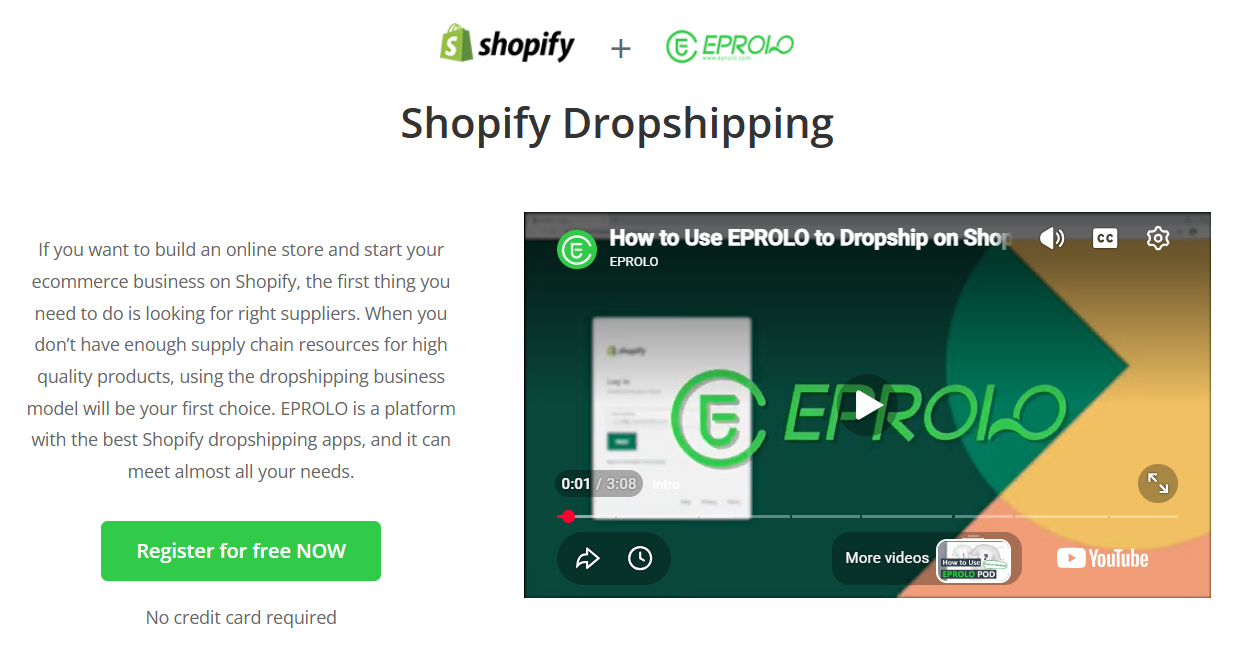
Finally, match the platform to the long-term model. Choose Shopify for rapid testing, direct EPROLO integration, and a wide supplier-app ecosystem. Consider BigCommerce for a complex, multichannel, or hybrid catalog where native commerce controls have greater value. If uncertainty remains, build the same small product set in each trial and measure setup time, required apps, and order-flow reliability.
FAQs about BigCommerce vs Shopify
Is Shopify or BigCommerce better for dropshipping?
Shopify is usually better for beginners and merchants who want the widest supplier-app choice, including direct access to the EPROLO Shopify app. BigCommerce can be better for a mixed or complex catalog when its native inventory, promotion, review, and multichannel tools reduce other app requirements.
Which is cheaper, Shopify or BigCommerce?
Their three main self-serve plans currently share the same US headline prices. The cheaper platform depends on payment-provider fees, processing rates, apps, BigCommerce GMV thresholds and overages, and development needs. Compare a 12-month total rather than subscription price alone.
Which is better for SEO, Shopify or BigCommerce?
Neither platform is automatically better for rankings. Shopify offers a simpler technical baseline and extensive SEO apps. BigCommerce offers flexible URL, metadata, redirect, sitemap, robots, and storefront controls. The better choice is the one your team can configure consistently while publishing useful, crawlable content.
Related Reading
- Wix vs Shopify (2026): Which Platform Builds a Stronger Online Store?
- Shopify vs WooCommerce Dropshipping 2026: Pick the Best Platform
- How to Vet a Dropshipping Supplier Before You Add Products to Shopify
- Dropshipping vs. Ecommerce: What's the Difference and Which Is Right for You?
- How to Fulfill Orders on Shopify Dropshipping: A Complete Guide
Written by
Inverse is a Google SEO operations specialist with experience in technical audits, keyword strategy, evidence-led content renewal, and ecommerce organic growth. The focus is on clear claims, current sources, and practical guidance that merchants can validate before acting.
Editorial note: Pricing, fees, plan names, and app availability were checked against current official Shopify, BigCommerce, and EPROLO sources. Terms vary by country, payment provider, sales volume, app plan, and supplier, so merchants should verify account-specific costs before choosing or migrating.